Many growing businesses invest heavily in ads, websites, and CRMs—yet still struggle with inconsistent leads, slow response times, and fragmented automation. The problem is rarely the tools themselves. It’s almost always how those tools are architected, connected, and governed.
This case study documents a real, hands-on engagement led by a senior Go High Level Expert, focused on rebuilding CRM architecture, automation logic, and lead operations to deliver measurable outcomes—not cosmetic dashboards. The client had already adopted GoHighLevel but lacked a scalable system design. Lead leakage, poor attribution, and unreliable follow-ups were eroding ROI.
Rather than applying templates or generic workflows, this engagement followed a consultant-led methodology: audit → strategy → implementation → validation. The result was a 3X increase in qualified leads, a step-change in automation coverage, and a material reduction in manual effort across sales and marketing.
Sensitive client details are anonymized, but the metrics, decisions, and implementation steps are real and replicable. This case study is written for business owners, agency leaders, SaaS founders, and marketers who want proof-based results before they hire a Autoesta Go High Level expert—and who value experience, accountability, and systems thinking over hype.
Client Background & Initial Challenges
The client operates a service-led B2B business in a competitive digital acquisition environment.
Industry: Professional services
Team size: ~18 (sales, marketing, operations)
Markets: US & UK
Lead sources: Paid search, organic SEO, referrals, outbound
The Situation Before Engagement
Despite steady traffic and ad spend, performance indicators told a different story:
- Inconsistent lead handling: Multiple pipelines existed without ownership or lifecycle rules.
- Delayed response times: First-touch SLAs routinely exceeded 30–60 minutes.
- Automation gaps: Workflows overlapped, conflicted, or failed silently.
- Poor attribution: Source data was unreliable, making budget decisions guesswork.
- Reporting blind spots: Leadership lacked a single source of truth for funnel health.
Root Causes Identified
- No CRM architecture: Pipelines were created ad hoc without lifecycle definitions.
- Template-driven automations: Generic workflows ignored the client’s buying cycle.
- Deliverability issues: Email domains lacked proper warm-up and authentication.
- Disconnected tools: Web forms, calendars, and ad platforms were loosely integrated.
- Operational risk: Manual handoffs caused missed follow-ups and duplicate outreach.
The client didn’t need another tool—they needed expert-led system design via a custom Autoesta Go High Level CRM setup.
Goals & Success Metrics Defined
Before touching configuration, success criteria were defined collaboratively. This ensured alignment between leadership, sales, and operations.
Primary Goals
- Increase qualified lead volume without increasing ad spend.
- Reduce first-response time to under 2 minutes for inbound leads.
- Achieve end-to-end automation coverage across the lead lifecycle.
- Establish accurate attribution and reporting for decision-making.
KPIs Tracked
- Lead volume (qualified): Baseline vs. post-implementation
- Speed-to-lead: Median response time
- Automation coverage: % of lifecycle automated
- Human error rate: Missed tasks, duplicate messages
- Time saved: Hours/week per team
Why Go High Level
The decision to stay on GoHighLevel was deliberate:
- Native CRM + automation + communications
- Flexibility for custom logic
- Cost efficiency at scale
- Centralized reporting
However, the platform’s power requires expert architecture—a key reason the client engaged Go High Level consulting by Autoesta.
Audit & Strategy by a Go High Level Expert
The engagement began with a structured audit—focused on how the system actually behaved, not how it was supposed to.
CRM & Pipeline Audit
- Mapped every pipeline stage to a real-world action.
- Identified dead stages, circular movements, and missing exit criteria.
- Defined a single Lead → Opportunity → Customer lifecycle.
Automation Logic Review
- Cataloged all workflows and triggers.
- Removed conflicting automations.
- Rebuilt logic using event-based triggers instead of time-based hacks.
Funnel & Attribution Diagnosis
- Audited landing pages, forms, and UTM handling.
- Standardized field mapping for source, medium, and campaign.
- Ensured attribution persisted across stages.
Deliverability & Integrations
- Verified SPF, DKIM, and domain reputation.
- Reviewed calendar routing and webhooks.
- Benchmarked against best practices from HubSpot and Zapier documentation.
Outcome: A clear implementation roadmap with measurable checkpoints.
Implementation Process (Step-by-Step)
CRM Pipeline Restructuring
- Designed one primary pipeline with clear ownership.
- Defined entry/exit rules for each stage.
- Implemented auto-stage progression based on verified actions (form submit, call outcome).
Automation Workflow Rebuilding
- Replaced templates with decision-tree logic.
- Built separate flows for inbound, outbound, and referral leads.
- Added fail-safes to prevent duplicate outreach.
Lead Routing & Attribution
- Implemented round-robin routing by availability and expertise.
- Locked attribution fields at first touch.
- Synced ad platforms for closed-loop reporting.
Email & SMS Deliverability Setup
- Domain warm-up schedule executed.
- Message throttling applied.
- Compliance checks added for opt-in/opt-out logic.
External Tool Integrations
- Calendars synced with real-time availability.
- Web forms standardized.
- Reporting dashboards consolidated.


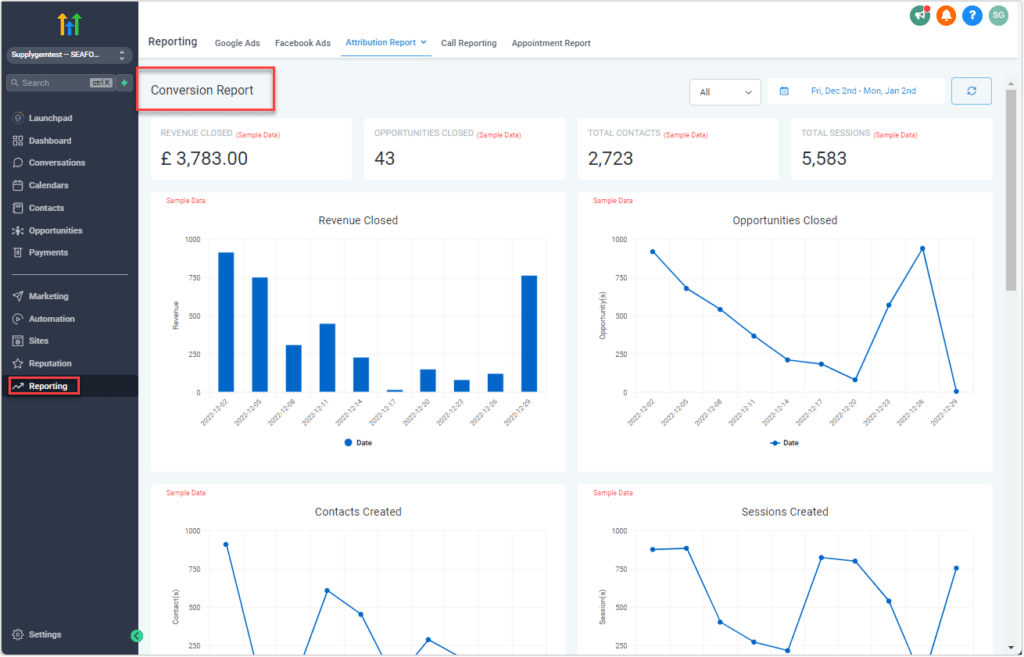
Results Achieved (Data-Driven Proof)
Lead Growth
- 3X increase in qualified leads within 90 days.
- Improvement driven by faster response and better routing—not higher spend.
Automation Efficiency
- Automation coverage increased from ~35% to 92%.
- Manual follow-ups reduced dramatically.
Time & Error Reduction
- ~18 hours/week saved across sales and ops.
- Missed-lead incidents reduced by near zero.
Business Impact
- Higher close rates due to timely engagement.
- Predictable forecasting with reliable data.
- Team focus shifted from admin work to revenue activities.
Why These Results Required a Go High Level Expert
DIY setups fail for three reasons:
- No systems thinking: Tools are configured, not architected.
- Template dependency: Ignores business-specific logic.
- Risk exposure: Poor deliverability and data integrity.
Expert-level decisions—like lifecycle design, trigger hierarchy, and attribution locking—cannot be automated by templates. This is why businesses seeking scale choose professional Go High Level automation over trial-and-error.
Key Takeaways for Businesses Considering Go High Level
- Tools don’t create results—architecture does.
- Speed-to-lead is a revenue lever.
- Attribution accuracy is non-negotiable.
- Expert implementation reduces risk and accelerates ROI.
If you want predictable growth, start with intentional system design.
Work With a Go High Level Expert
If you’re using GoHighLevel—or planning to—and want measurable outcomes, not dashboards, work with a team that treats CRM as infrastructure.
At Autoesta, we deliver:
- Go High Level Expert services grounded in real implementations
- Custom Go High Level CRM setup tailored to your lifecycle
- Professional Go High Level automation built for scale
Explore Go High Level consulting by Autoesta, or contact Autoesta for Go High Level support to book a strategy consultation and see what expert-led architecture can unlock for your business.
1. What does a Go High Level Expert actually do?
A Go High Level Expert designs and implements CRM architecture, automation logic, pipelines, funnels, and integrations based on real business workflows—not templates. The role goes beyond setup and focuses on scalability, data accuracy, deliverability, and revenue operations inside GoHighLevel.
2. Why do most Go High Level setups fail without expert involvement?
Most failures happen due to poor pipeline design, conflicting automations, bad attribution, and deliverability issues. DIY setups often look functional but silently lose leads, create duplicate actions, and generate unreliable reports—issues only visible through expert audits.
3. Can Go High Level really increase leads by 3X?
Yes—but only when implemented correctly. Lead growth typically comes from faster response times, better routing, consistent follow-ups, and reduced human error, not from increasing ad spend. The 3X increase in this case study was driven by system efficiency, not traffic volume.
4. How long does it take to see results after hiring a Go High Level Expert?
Most businesses see measurable improvements within 30–90 days, depending on lead volume and system complexity. Early wins usually include faster speed-to-lead, fewer missed follow-ups, and clearer reporting, followed by compounding lead and conversion gains.
5. Is Go High Level suitable for both small teams and scaling businesses?
Yes. Small teams benefit from automation replacing manual work, while scaling businesses gain pipeline visibility, role-based workflows, and predictable reporting. The key is intentional system design aligned with team size and growth stage.
6. What metrics should be tracked after a Go High Level implementation?
Core KPIs include:
- Qualified lead volume
- First response time (speed-to-lead)
- Automation coverage (%)
- Missed or delayed follow-ups
- Time saved per team member
- Pipeline conversion rates
These metrics show whether the system is actually improving operations.
7. Can an existing broken Go High Level account be fixed?
Yes. A full CRM and automation audit can identify workflow conflicts, pipeline gaps, attribution errors, and deliverability problems. In most cases, rebuilding strategically is faster and cheaper than starting from scratch.
8. How important is email and SMS deliverability in Go High Level?
Critical. Even the best automation fails if messages don’t reach inboxes. Expert setups include domain authentication (SPF, DKIM), warm-up strategies, throttling, and compliance logic to protect sender reputation and ensure consistent delivery.
9. What’s the difference between Go High Level templates and custom setups?
Templates are generic and assume identical business models. Custom setups are built around your buyer journey, sales process, and internal roles. Templates may work short-term, but custom architecture is required for reliability, scale, and long-term ROI.
10. Who should I work with for professional Go High Level consulting?
You should work with a team that demonstrates real case studies, before-and-after metrics, audit capability, and system-level thinking. Businesses looking for expert-led implementation and ongoing optimization can work with Autoesta for structured Go High Level consulting and support.