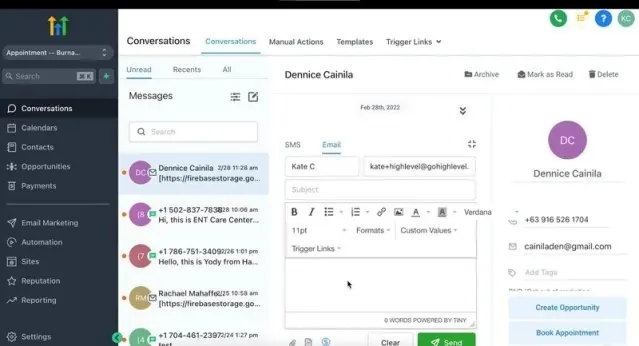
What is an AI chat agent?
An AI chat agent is a conversational assistant that answers visitor and customer questions in natural language, using your own approved information, and can qualify the person and book an appointment inside the same conversation.
It differs from two things you may already know. A rule-based chatbot follows a fixed decision tree and breaks the moment someone types something unexpected. Live chat needs a person online. An AI chat agent understands free-form questions, replies instantly at any hour, and hands over to a human when the conversation needs one.
The value for a business is straightforward. Most website visitors do not fill in a form on their first visit, and most enquiries come with a question the page did not fully answer. An agent that answers that question in seconds, then offers the next step, converts interest that would otherwise leave. Autoesta builds these agents inside GoHighLevel so each conversation becomes a contact, a pipeline entry, and, where appropriate, a booked appointment.
Where can an AI chat agent operate?
The same agent logic can serve several channels, depending on what your platform supports and what your customers use:
- Website chat widget for visitors reading your service pages.
- SMS for replies to enquiries and follow-ups (subject to consent and registration rules, covered in our setup guide).
- Social direct messages such as Facebook Messenger and Instagram, where many people first reach out.
- Messaging apps and business profile chat where supported.
The important design point is that one knowledge base and one set of rules should power every channel, so a customer gets consistent answers whether they type on your site or text you. It should also work alongside an AI calling agent for people who would rather talk.
What can an AI chat agent actually do?
An AI chat agent answers visitor questions, qualifies leads and books calls, inside the rules you set.
Answer questions from your own content
Services, pricing rules you have approved, hours, locations, preparation instructions, policies, and the questions your front desk answers ten times a day.
Qualify the visitor
By asking the same questions your team would (what they need, where they are, when they want it, roughly what they can spend) it separates serious enquiries from casual ones, and records the answers in the contact record.
Book appointments
The agent can offer available slots and book directly into your calendar. Removing the "go to another page and fill in a form" step is one of the highest-impact changes you can make to a conversion path.
Capture contact details
It asks for name and contact information at a natural point in the conversation, creating the contact and starting your follow-up workflow.
Support existing customers
Rescheduling, opening hours, "what do I need to bring?" and other routine requests, leaving your team free for the exceptions.
Hand over to a human
When a person replies, or the agent decides the situation needs one, it steps back. A clean handover, with the whole conversation visible to the staff member, matters as much as any answer it gives.
How a chat becomes a booking
How do you keep an AI chat agent accurate?
You keep it accurate by restricting it to a knowledge base you have reviewed, telling it exactly what it must not do, and testing it with hard questions before customers ever see it.
Language models can produce fluent, confident, wrong answers, which is the main risk of any AI assistant. The controls we apply:
- Approved sources only. The agent answers from a curated knowledge base (your service pages, price rules, policies, FAQs), not from general internet knowledge.
- "I don't know" is a valid answer. When information is missing, the agent offers to connect the person with your team instead of guessing.
- Explicit prohibitions. No promises about results, no medical, legal, or financial advice, no unapproved pricing or discounts, no commitments on your behalf.
- Limited actions. The agent can do only what its role requires (create a contact, offer slots, book), not everything the platform can do.
- Resistance to manipulation. People sometimes try to make an assistant ignore its instructions. Rules and permissions are designed so that trying does not give it access to anything harmful.
- Regular review. Transcripts are read, wrong or awkward answers are corrected, and the knowledge base is updated when your business changes.
What keeps the agent inside its lane
How do you prepare the knowledge base?
The quality of your agent is largely the quality of what you give it. A useful starting inventory:
- The top 30 to 50 questions customers actually ask, taken from emails, calls, and reviews.
- Service descriptions written plainly, including what is not included.
- Pricing guidance: what may be stated (a range, a starting point, "from") and what must be quoted by a person.
- Location and service-area facts, hours, and holiday closures.
- Policies: cancellations, deposits, refunds, insurance.
- Qualification criteria: what makes someone a good fit, and what makes them not.
- Tone guidance: formal or relaxed, and a few example replies.
- A "never say" list.
Keep one owner responsible for updating it. An agent that quotes last year's hours or a discontinued service is worse than no agent.
How should the conversation be designed?
Design the conversation around the questions visitors ask most, with a clear handoff to a person when needed.
- Answer first, then ask. A visitor who asks a question and receives a form request will leave. Answer, then offer a next step.
- One question at a time, and short messages. Chat is a fast medium.
- Explain why you are asking. "To check we cover your area, what's your postcode?" gets better answers than a bare question.
- Offer clear options when choices are finite (buttons or quick replies) and free text when they are not.
- Ask for contact details late enough to be earned, but early enough not to lose the person.
- Make the human option visible. "Talk to a person" should never be hard to find.
- Close with a confirmation of what happens next and when.
How does it work with GoHighLevel?
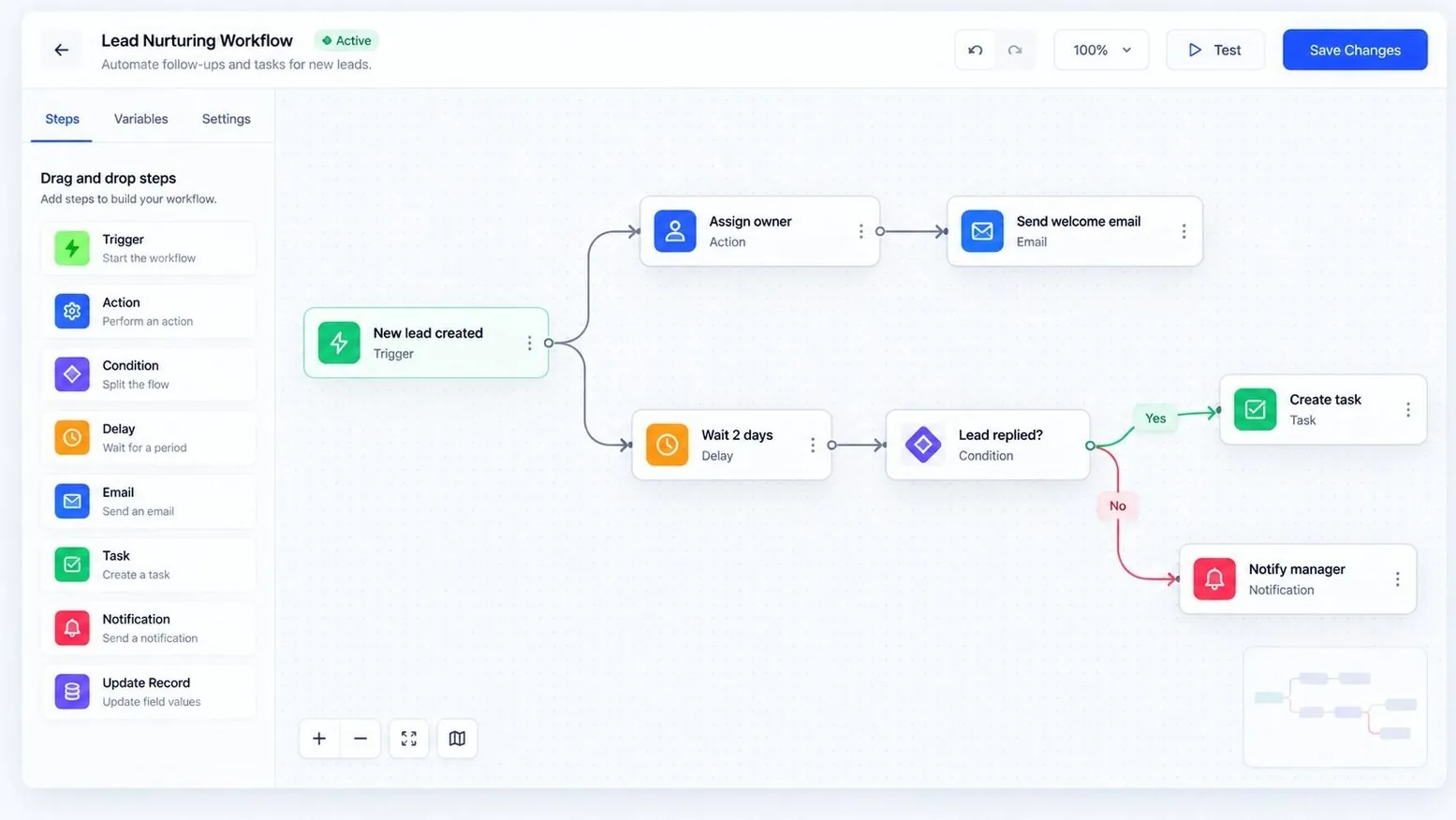
Inside GoHighLevel, each chat becomes part of the contact's conversation history alongside SMS and email. In a proper build:
- A contact is created or matched as soon as the visitor gives an email or phone number.
- Answers to qualifying questions are saved to custom fields, so your team sees them without reading the transcript.
- Tags and pipeline stages update automatically (for example "chat enquiry, qualified").
- Bookings go straight to the right calendar.
- Workflows start: confirmations, reminders, and nurture sequences.
- The agent pauses when a human takes over the conversation.
- Consent is recorded where you collect a phone number for messaging.
Where you need data to move to systems outside GoHighLevel, n8n or Zapier handles it. If your existing chat or conversation setup is already misbehaving, see our account audit.
What about privacy and data protection?
Chat conversations often contain personal information, so treat them accordingly:
- Tell visitors they are talking to an AI assistant, and link to your privacy policy.
- Do not ask for sensitive data (health details, payment card numbers, government IDs) in chat unless you have a lawful, secure process for it. Where the agent should not handle such data, instruct it to redirect the person to a secure channel.
- Decide how long transcripts are kept and who can read them.
- Respect opt-outs and deletion requests as your local law requires.
- Understand where data is processed by the platform and the language-model provider, and reflect that in your policies.
AI chat agent, live chat, chatbot, or contact form: which is right?
Each option fits a different moment, and the right one depends on how fast your team can reply.
| AI chat agent | Live chat | Rule-based chatbot | Contact form | |
|---|---|---|---|---|
| Available 24/7 | Yes | Only if staffed | Yes | Yes |
| Handles unexpected questions | Yes | Yes | No | Not applicable |
| Response speed | Instant | Depends on staffing | Instant | Delayed |
| Can book directly | Yes | Manually | Limited | No |
| Risk of wrong answers | Managed with knowledge base and guardrails | Human error | Low but rigid | None |
| Ongoing effort | Knowledge base upkeep and review | Staff time | Maintenance of rules | Minimal |
A form is still useful for people who prefer it, and AI chat should sit alongside your page's main call to action, not replace it. Our landing page work shows how the two fit together on a conversion-focused page.
How do you measure an AI chat agent?
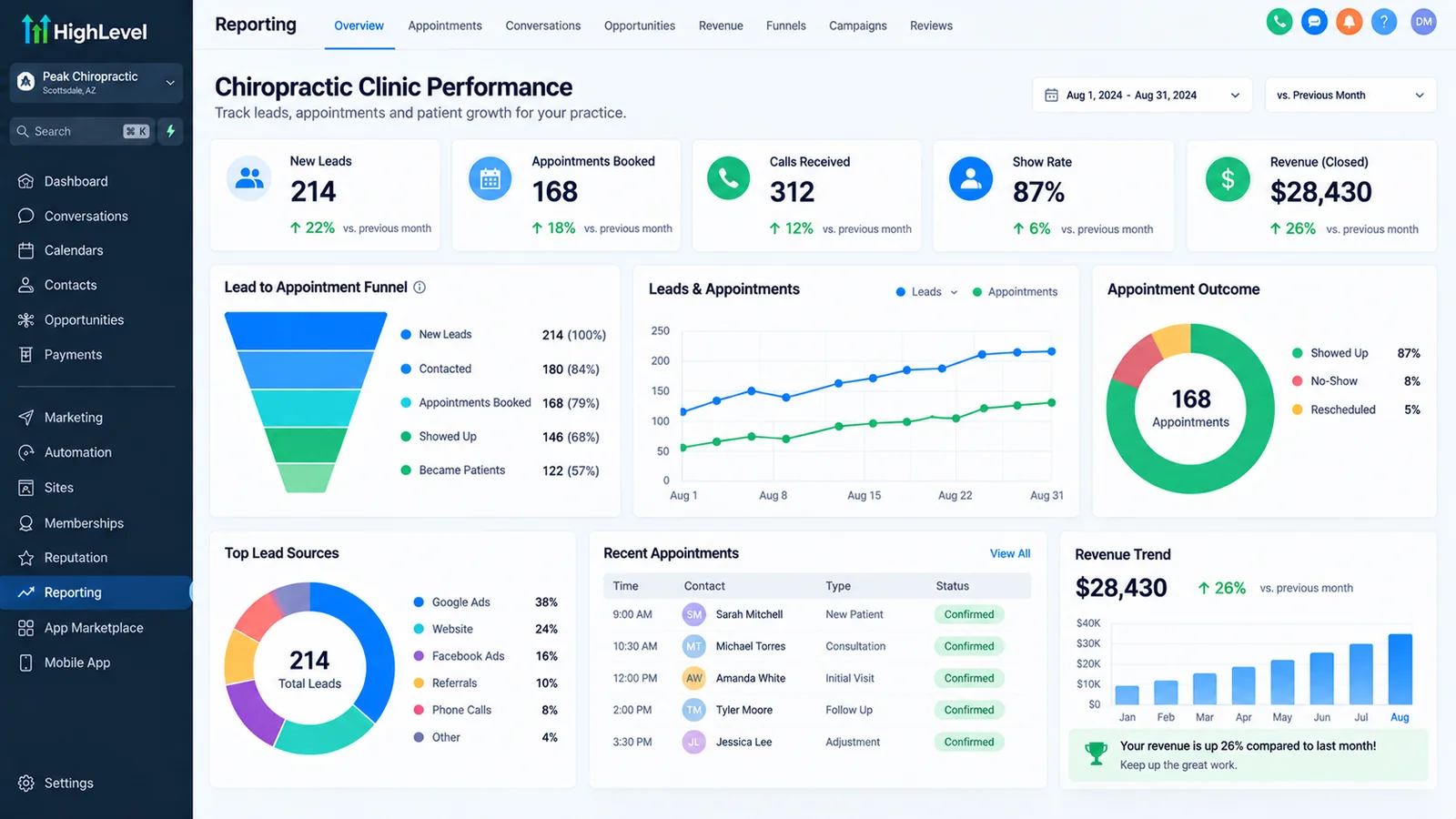
Measure the agent with the numbers below, reviewed against your baseline before launch.
- Conversation-to-contact rate: the share of chats that produce contact details.
- Conversation-to-booking rate: the share that end in a booking.
- Answer quality: reviewed on a sample of transcripts each week, scored as correct, partly correct, or wrong.
- Handover rate and reasons: shows where the knowledge base is thin.
- Unanswered questions: your best source for new content and knowledge base additions.
- Time to first response: should be seconds.
We do not promise a conversion uplift in advance because it depends on your traffic, offer, and current conversion path. We do set up the measurement so you can see the change and decide whether it is worth continuing.
What does an AI chat agent cost?
Costs have a build component (knowledge base, conversation design, integration, testing) and a usage component (the platform and language-model usage, which is typically metered by conversation or message volume). Because both vary with scope and provider pricing changes, we confirm figures on a strategy call rather than publish a number that would be wrong for many businesses. The agent is scoped as part of a larger build or added to an existing system (see the setup page).
What are the limits of AI chat?
An AI chat agent works well inside a defined scope and hands everything else to a person.
- It is only as good as its knowledge base, and out-of-date information produces wrong answers.
- It should not handle emergencies, complaints involving harm, or decisions that need professional judgement.
- Some people prefer a human, and forcing them to argue with automation damages trust.
- Long, complicated negotiations still need a person.
- It cannot fix a weak offer or a confusing website. It can only help a good one convert.
How do you roll out an AI chat agent safely?
Roll it out in stages, starting with a small set of pages and questions, and review the transcripts each week.
- Define one goal (for example: answer service questions and book consultations).
- Build the knowledge base and rules.
- Test with a long list of real questions, hard questions, and attempts to break it.
- Soft launch on a subset of pages or in "suggest but do not send" mode where staff approve replies at first.
- Review transcripts daily for the first week, then weekly.
- Expand to more pages and channels once quality is proven.
What does a sample chat conversation look like?
An illustrative flow for a service business (wording will be tailored to yours). The visitor is on a pricing page.
Visitor: Do you cover the north side of town?
Agent: Yes, we serve most of the north side, including the areas around [area names]. Could you tell me your postcode so I can confirm?
Visitor: [postcode]
Agent: Good news, that is within our area. What are you looking to get done?
Visitor: I need a quote for [service].
Agent: Happy to help. Quotes depend on the details, so the quickest way is a short call with one of our team. I can book one now. Would tomorrow morning or afternoon suit you?
Visitor: Morning.
Agent: I have 9:30 or 11:00. Which do you prefer, and what is the best number to reach you on?
Notice the pattern: it answers first, asks one question at a time, explains why it asks, and moves to a booking without a form. If the visitor asks something outside its knowledge, such as an unusual price or a complaint, it offers to connect them with a person instead of guessing.
What is a launch checklist for an AI chat agent?
Check these items before the agent goes live on your site.
- Knowledge base reviewed and approved by someone who knows the business.
- Prohibited topics and promises written into the rules.
- Disclosure that the visitor is chatting with an AI assistant.
- Consent and privacy links in place where contact details are collected.
- Human handover tested at the times staff are actually available, with a fallback for after hours.
- Calendar booking tested end to end, including time zones.
- Contact creation, tags, and pipeline stage verified in the CRM.
- At least fifty real and adversarial test questions run and reviewed.
- Transcript review scheduled for the first week and every week after.
- A named person responsible for keeping the knowledge base current.
If you want to see what HighLevel's native AI agents do and cost before hiring anyone, read our guide.
If a phone agent is on your list too, we compared the voice agent platforms that work with GoHighLevel.
Not sure whether chat or voice fits your lead flow? See when to use chat, calling, or both.
More questions about AI chat agents
Will it replace my staff?
No, it takes the repetitive first response and routine questions so staff can spend time on conversations that need judgement.
Can it be trained on my website?
Yes, your site content is a natural starting point for the knowledge base, along with policies and FAQs that may not be on the site.
What if it gives a wrong answer?
That is why we restrict it to approved information, add "I don't know" behaviour, review transcripts, and correct the knowledge base when something slips.
Does it work in other languages?
Modern models handle many languages, but quality varies, so we test each language you need before launch.
Can visitors tell it is AI?
We recommend making it clear that visitors are talking to AI. Honesty builds trust and is expected or required in some places.
Can it use my brand voice?
Yes, we write tone guidance and sample replies so it sounds like your business.
How do I get started?
Book a call on the contact page to start. We will look at your site and enquiries and tell you whether a chat agent would help, and where.
Can an AI chatbot book appointments?
Yes, an AI chatbot that books appointments checks your calendar, offers times and books the slot inside the conversation, then sends the confirmation and reminders through your CRM.
Does a 24/7 AI chatbot for leads replace live chat?
It covers the hours nobody is online and the repeat questions, and hands off to a person for anything unusual or high value. An AI chatbot for business works best as the first reply, with a clear handoff rule, not as a wall between the customer and your team.
What is the difference between a chat agent service and a chatbot?
A simple chatbot follows fixed buttons and scripts. A chat agent service uses an AI model grounded in your own information, qualifies the visitor, books or routes them, and writes everything to the CRM.
Related: AI agents for business, AI agent adoption statistics and whether an AI agent replaces staff.
Chat agents work best inside a structured sequence. See lead follow-up that converts for how the stop rules and handoffs are designed.