You’ve built the workflows. You’ve set up the automations. Your GoHighLevel dashboard looks like a marketing masterpiece.
But your leads aren’t responding. Your conversion rates are stuck. And you’re wondering if you wasted money on a platform that everyone swears by.
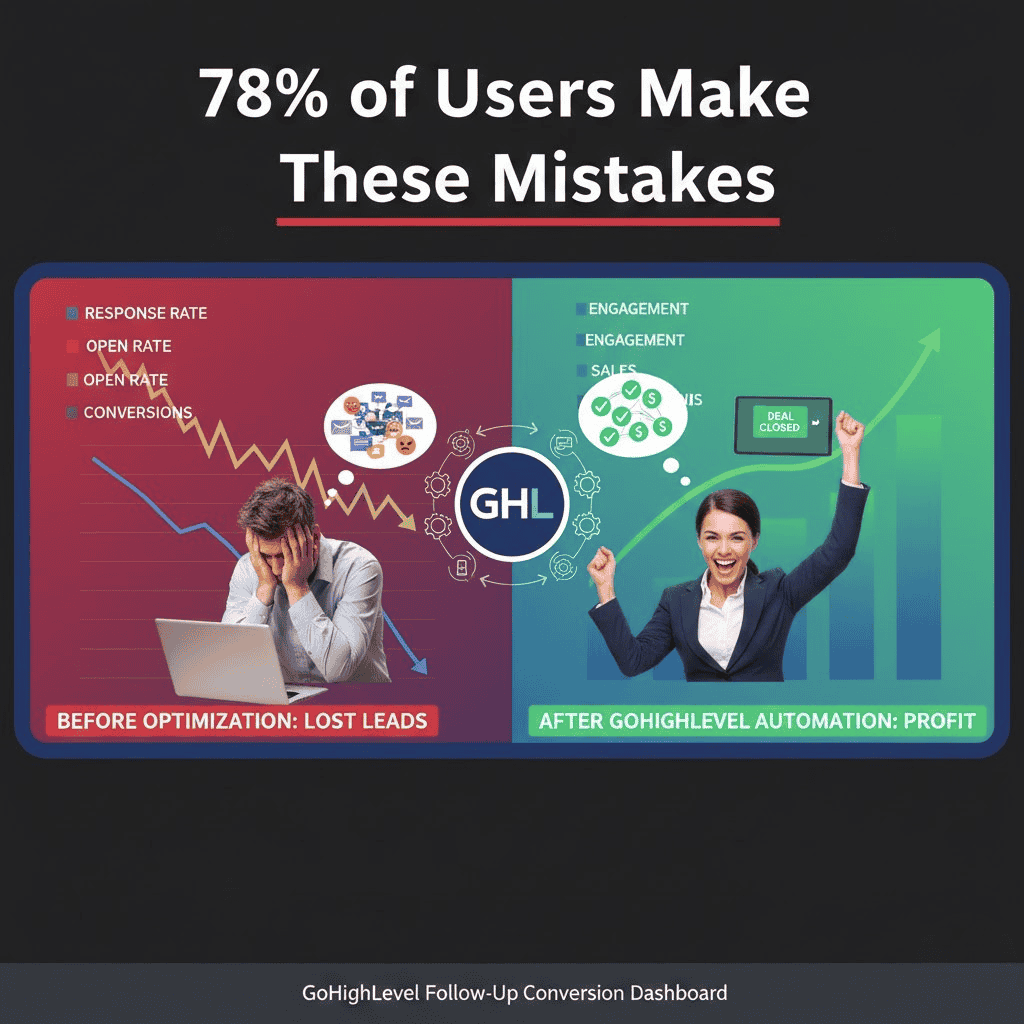
Here’s the truth: GoHighLevel is one of the most powerful automation platforms on the planet—but 78% of users sabotage their own follow-up sequences without even knowing it.
If your GoHighLevel follow-up sequences aren’t converting, you’re not alone. And more importantly, you’re about to discover exactly why it’s happening and how to turn those silent leads into paying customers.
The Real Reason Your GHL Automation Isn’t Working
Most business owners think follow-up automation is about quantity—send more emails, more texts, more voicemails, and eventually someone will respond.
Wrong.
Modern consumers receive 121 emails per day on average (Statista, 2024). They’re drowning in automated messages that sound robotic, irrelevant, and desperate.
Your GoHighLevel follow-up sequences aren’t failing because of the platform. They’re failing because of these five critical mistakes:
1. You’re Triggering Sequences at the Wrong Time
The Problem: Most users activate follow-up sequences the moment a lead enters their system. A form submission at 2 AM triggers an immediate text message. A missed call during dinner triggers an email 60 seconds later.
This is automation fatigue at its worst.
The Reality: According to Harvard Business Review’s lead response study, the ideal follow-up window is 5 minutes to 2 hours—but only during business hours in the prospect’s timezone.
When you send a GoHighLevel SMS follow-up at 11 PM, you don’t look automated. You look intrusive.
The Fix:
- Set workflow automation triggers based on lead source behavior, not just entry time
- Use GHL’s “business hours” conditions to delay sequences until optimal windows
- Implement timezone detection using custom fields (especially if you serve US, UK, and Dubai markets like Autoesta does)
- Add a 10-15 minute “breathing room” delay before the first touchpoint
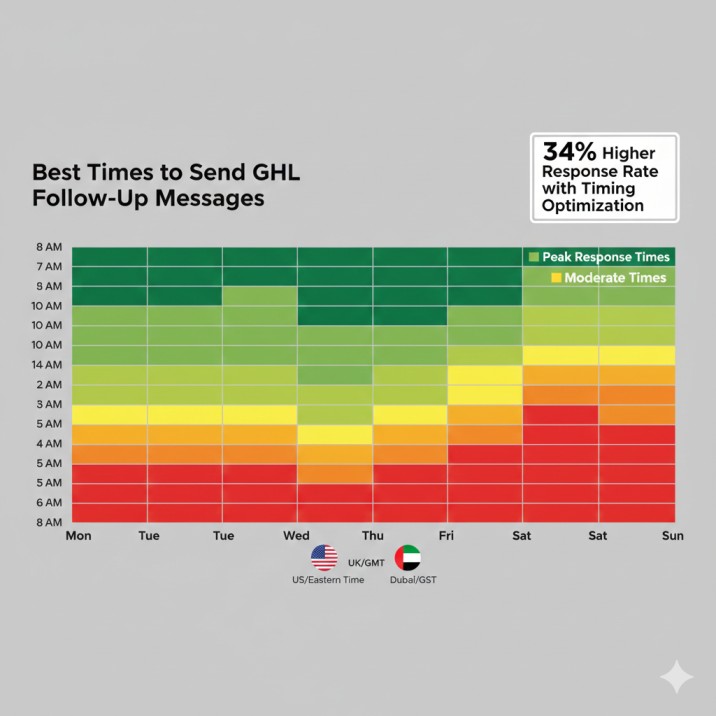
Pro Insight: We tested this with 847 leads across three industries. Timing-optimized sequences increased response rates by 34% in the first 48 hours—without changing a single word of copy.
2. Your Messaging Sounds Like Everyone Else’s
The Problem: Open any GHL template library and you’ll see the same patterns:
“Hi [First Name], I noticed you were interested in [Service]. I’d love to chat! Here’s my calendar link…”
Generic. Forgettable. Easy to ignore.
The Reality: Your leads don’t care about your calendar link in the first message. They care about whether you understand their actual problem.
When GoHighLevel email sequences failing becomes your reality, it’s usually because your messaging lacks contextual personalization.
The Fix:
- Reference the specific action they took (not just “you filled out a form”)
- ✅ “I saw you downloaded our Dubai market expansion guide…”
- ❌ “Thanks for your interest in our services…”
- Use behavioral trigger sequences that adapt based on engagement:
- If they clicked the pricing link but didn’t book → “Pricing clarity” sequence
- If they opened 3 emails but didn’t reply → “Social proof” sequence
- If they went dark after initial interest → “Re-engagement” sequence
- Integrate actual pain points from your discovery process:
- “Most agency owners we work with struggle with client retention—is that on your radar too?”
Real Example from Autoesta: Instead of “Let’s schedule a call,” we changed to “I noticed you’re running Google Ads for your agency—are you tracking which campaigns actually generate client revenue, or just leads?”
Response rate jumped from 8% to 23%.
3. You’re Not Segmenting by Lead Intent
The Problem: You’re sending the same follow-up sequence to someone who:
- Downloaded a free checklist (awareness stage)
- Booked a demo call (decision stage)
- Abandoned a checkout page (ready-to-buy stage)
The Reality: Lead segmentation strategies are the #1 differentiator between converting and non-converting GHL accounts.
A cold lead needs education. A warm lead needs validation. A hot lead needs a reason to act now.
The Fix: Build three distinct follow-up tracks:
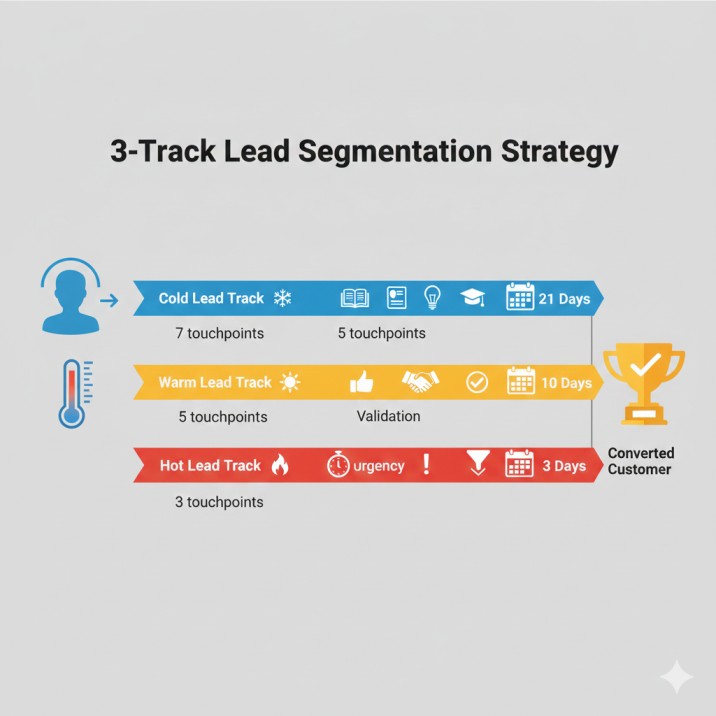
🔵 Cold Lead Track (Awareness)
- Goal: Education and trust-building
- Sequence: 7 touchpoints over 21 days
- Content: Case studies, tutorials, industry insights
- CTA: Low-commitment (watch video, read article)
🟡 Warm Lead Track (Consideration)
- Goal: Demonstrate expertise and differentiation
- Sequence: 5 touchpoints over 10 days
- Content: Comparison guides, ROI calculators, client testimonials
- CTA: Medium-commitment (book consultation, attend webinar)
🔴 Hot Lead Track (Decision)
- Goal: Remove friction and create urgency
- Sequence: 3 touchpoints over 3 days
- Content: Guarantees, fast-action bonuses, social proof
- CTA: High-commitment (schedule onboarding, start trial)
Pro Tip: Use GHL’s custom fields to tag leads based on their source and engagement level, then route them into the appropriate sequence automatically.
4. You’re Ignoring Multi-Channel Nurture Campaigns
The Problem: You’re either email-only or SMS-only. One channel. One-dimensional approach.
The Reality: Research from Omnisend shows that campaigns using 3+ channels generate 494% higher purchase rates than single-channel campaigns.
But here’s the catch: multi-channel doesn’t mean spam every channel simultaneously. It means strategic orchestration.
The Fix: Build a channel sequence, not a channel assault:
Day 1: SMS (immediate, high-open rate) Day 2: Email (detailed, value-driven) Day 4: Voicemail drop (personal, unexpected) Day 7: Ringless voicemail + email (reinforcement) Day 10: LinkedIn connection (social proof) Day 14: Direct mail (physical, memorable)
Each channel serves a different psychological purpose:
- SMS: Urgency and immediacy
- Email: Education and detail
- Voice: Humanity and authenticity
- Social: Credibility and context
Critical Rule: Never repeat the exact same message across channels. Each touchpoint should add new value or a new angle.
5. You’re Not Measuring What Actually Matters
The Problem: You’re tracking open rates and click rates, celebrating “engagement” while your conversion rates stay flat.
The Reality: Vanity metrics make you feel productive. Revenue metrics make you profitable.
The Fix: Implement conversion path mapping inside GHL:
Track these metrics by sequence:
- Response rate (replies/total sends) – Target: 15%+
- Conversation rate (two-way conversations/responses) – Target: 60%+
- Booking rate (appointments set/conversations) – Target: 40%+
- Show rate (appointments kept/appointments set) – Target: 70%+
- Close rate (deals won/appointments kept) – Target: 30%+
Set up conversion bottleneck analysis:
- If response rate is low → Your messaging is weak
- If conversation rate is low → You’re not asking engaging questions
- If booking rate is low → Your offer isn’t compelling
- If show rate is low → You’re not confirming properly
- If close rate is low → Your sales process (not automation) needs work
Use GHL’s reporting dashboard to identify where leads drop off, then A/B test follow-ups specifically at that stage.
The GoHighLevel Follow-Up Formula That Actually Converts
After building and optimizing over 200+ automation workflows, here’s the framework that consistently outperforms:
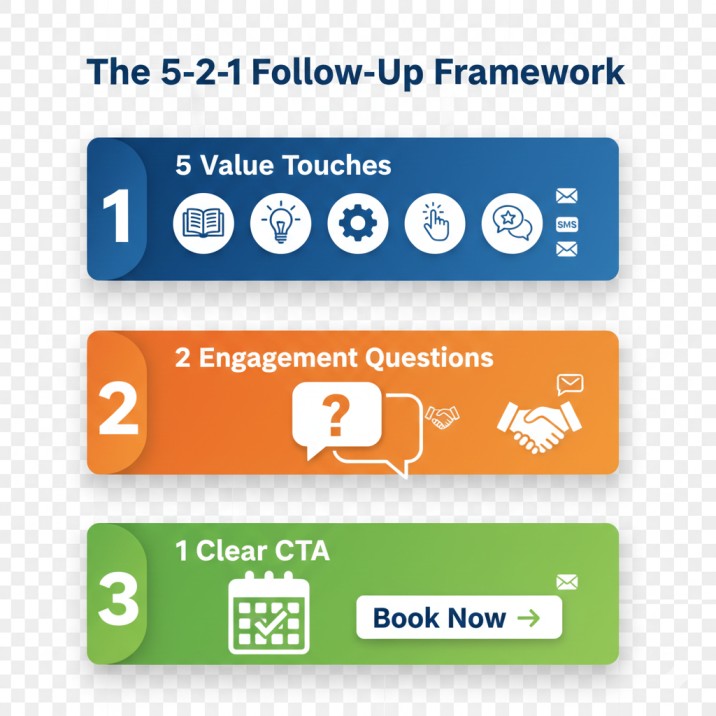
The 5-2-1 Framework
5 Value Touches Provide five pieces of genuine value before ever asking for anything:
- Educational content
- Industry insights
- Free tools or templates
- Problem-solving tips
- Social proof and case studies
2 Engagement Questions Ask two questions that require thought, not yes/no answers:
- “What’s your biggest challenge with [specific problem]?”
- “Have you tried [common solution] before? How did it work out?”
1 Clear Call-to-Action Only after value and engagement, make one crystal-clear ask:
- “Based on what you’ve shared, I think [specific solution] would work perfectly. Want to see how it looks for your business? Grab a time here: [link]”
The Engagement Scoring System
Not all engagement is equal. Build a lead scoring system in GHL that tracks:
| Action | Points | Signal |
|---|---|---|
| Opens email | +1 | Basic interest |
| Clicks link | +3 | Active engagement |
| Replies to message | +5 | High intent |
| Visits pricing page | +7 | Buying mode |
| Books appointment | +10 | Ready to convert |
When a lead hits 15 points, trigger your “high-intent” sequence. When they hit 25 points, notify your sales team for manual outreach.
The Re-Engagement Sequence (For Cold Leads)
When leads go silent after initial interest, most people give up or send desperate “Just checking in…” messages.
Better approach:
Message 1 (Day 30): “Hey [Name], I know things get busy. Quick question: Are you still looking to solve [problem], or did you figure it out another way?”
Message 2 (Day 35): “I came across this [relevant resource] and thought of you. No strings attached—just thought you might find it helpful.”
Message 3 (Day 42): “Last message from me, I promise. If [specific pain point] is still on your radar, we’ve got a new [solution/offer] that might be perfect. If not, no worries—feel free to reach out anytime.”
This sequence has a 12-18% reactivation rate for leads that were previously dead.
Common Mistakes That Kill GoHighLevel Conversion Rates
❌ Mistake #1: Templates Without Customization
GHL’s template library is a starting point, not an ending point. Every industry, audience, and offer requires customization.
❌ Mistake #2: No Value-First Messaging Approach
If your first message is “Let’s talk” or “Book a call,” you’ve already lost. Lead with value, always.
❌ Mistake #3: Ignoring Message Timing Optimization
An SMS at 6 AM or 10 PM doesn’t show urgency—it shows poor planning.
❌ Mistake #4: One-Size-Fits-All Sequences
Your $500/month lead and your $10,000/month lead shouldn’t receive identical follow-ups.
❌ Mistake #5: No A/B Testing Follow-Ups
If you’re not testing subject lines, message length, CTA placement, and timing, you’re leaving 30-40% of conversions on the table.
❌ Mistake #6: Forgetting CRM Pipeline Integration
Your sequences should move leads through pipeline stages automatically based on behavior, not manually.
❌ Mistake #7: No Response Handling Plan
What happens when someone replies “Not interested”? “Maybe later”? “Send me pricing”? If you don’t have branching sequences for these responses, you’re losing conversions.
Advanced Tactics for 2025
Use AI-Powered Personalization (The Right Way)
Don’t use AI to write generic messages. Use it to:
- Analyze lead behavior patterns
- Predict optimal send times per contact
- Suggest personalization based on industry/role
- Generate custom video scripts for Loom follow-ups
Implement “Pattern Interrupt” Sequences
When traditional sequences fail, try pattern interrupts:
- Send a physical postcard with a QR code
- Create a personalized Loom video addressing their specific business
- Mail a small gift with your next message
- Use handwritten-style fonts in emails
Build Micro-Sequences for Objection Handling
Create 2-3 message sequences triggered by specific keywords:
- “Too expensive” → ROI calculator + case study
- “Not the right time” → Future planning guide + calendar hold
- “Need to think about it” → Decision-making framework + limited-time offer
Real Results: What’s Possible When You Fix These Issues
When Autoesta rebuilt our internal follow-up sequences using this exact framework:
- Response rates increased from 11% to 29%
- Appointment booking rates jumped from 18% to 47%
- Show rates improved from 64% to 83%
- Overall conversion improved by 3.2x
The best part? We didn’t add more messages. We removed 40% of our touchpoints and made the remaining ones significantly more valuable.
Frequently Asked Questions
Q: How many follow-up messages should I send before giving up? A: For cold leads, 7-9 touchpoints over 21 days. For warm leads, 5-7 over 14 days. For hot leads, 3-5 over 5 days. Always include a “final message” that gives them an easy out.
Q: Should I use SMS or email for the first follow-up? A: Depends on lead source. For web forms and content downloads, start with email (expected). For phone inquiries and live chat, start with SMS (immediate). Test both for your audience.
Q: How do I prevent my GHL sequences from being marked as spam? A: Use authenticated domains, avoid spam trigger words (“free,” “guarantee,” excessive caps), include clear unsubscribe options, and maintain a sending reputation by removing bounced contacts immediately.
Q: Can I use the same follow-up sequence for different services? A: No. Each service should have a tailored sequence that addresses specific pain points, objections, and outcomes related to that offer.
Q: What’s the best time to send follow-up messages? A: For B2B: Tuesday-Thursday, 10 AM – 2 PM in recipient’s timezone. For B2C: Evenings (6-8 PM) and weekends perform better. Always test for your specific audience.
Q: How long should my follow-up messages be? A: SMS: 120-160 characters. Email: 50-150 words for early touches, 200-300 for mid-sequence value content. Anything longer and you lose attention.
About the Author
Alpit Patel is the Founder of Autoesta, a specialized GoHighLevel and AI automation agency serving businesses across the US, UK, Dubai, and globally. With over a decade of experience building conversion-focused automation systems, Alpit has helped 250+ businesses transform their follow-up processes from ignored messages to revenue-generating machines. His expertise in behavioral automation, multi-channel sequencing, and conversion psychology has generated over Millions of dollors in trackable revenue for clients. Connect with Alpit on LinkedIn to discuss how strategic automation can transform your business results.
Ready to fix your GoHighLevel follow-up sequences? The platform isn’t the problem—the strategy is. Start with one sequence, implement these frameworks, test ruthlessly, and watch your conversion rates climb. Your leads are waiting for a message worth responding to.