Case study at a glance
| Client | Care Star Healthcare, a home care agency based in Lithonia, Georgia |
|---|---|
| Problem | Recurring paperwork, such as release forms, medical record requests, plans of treatment (POT), and recertification packets, ran as manual, one-off tasks instead of a repeatable process. |
| What we built | A set of published GoHighLevel automations covering release forms, faxing medical records to physicians, POT review and sign-off, recertification dates, and SOC (start of care) packet delivery. |
| Platforms | GoHighLevel |
| Reported results | No-show rate down about 40%. Review volume up to 30 to 50 new Google reviews a week. |
Care Star Healthcare: reported results
Figures are reported by Autoesta for this client. Results vary by agency, referral volume, and caseload.
What problem did Care Star Healthcare have?
A home care agency's paperwork is repetitive by nature: every client needs a release form, a plan of treatment sent to and signed by a physician, a recertification on a schedule, and a start-of-care packet. Before this build, each of those ran as a one-off manual task rather than a process the same way every time.
That kind of paperwork is also where compliance risk lives: a plan of treatment that never gets faxed back signed, or a recertification date that slips, is an operational problem for a home care agency: missed care, delayed billing, compliance risk.
What did we build?
A set of GoHighLevel workflows that turn each recurring document into the same repeatable sequence every time: send the release form, fax the medical record request, route the plan of treatment for review and signature, fax it back to the physician, track the recertification date, and send the start-of-care packet.
The paperwork workflows we published
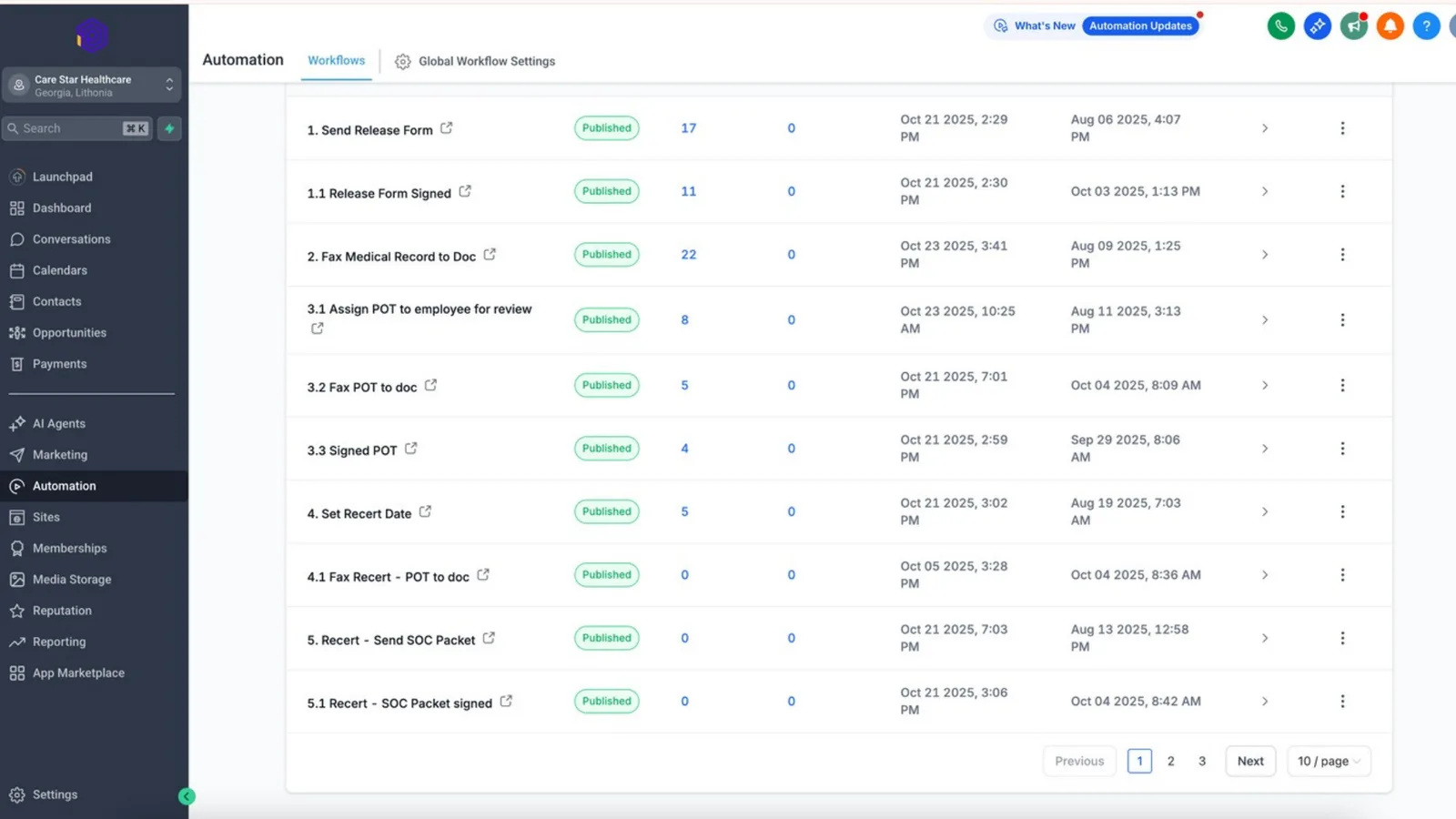
Each workflow triggers on a real event, a contact change, a form signature, a status update, rather than a person remembering to start the next step. See our guide to GoHighLevel for home care agencies for how this kind of build is usually scoped, and our API integrations page for how a workflow like this is kept reliable at the connection level.
What changed?
Reported by Autoesta: the no-show rate fell by about 40%, and the agency now gets 30 to 50 new Google reviews a week, up from an inconsistent, largely manual review-request process before.
| Measure | Reported change |
|---|---|
| No-show rate | Down about 40% |
| Google reviews | 30 to 50 new reviews a week |
| Recurring paperwork | Now a repeatable, published workflow instead of a manual one-off task |
We are not publishing a raw before number for review volume because we don't have a verified baseline beyond the agency's own account that it was inconsistent and largely manual before.
What about the no-show and review numbers?
The no-show reduction came from the same reminder logic described in our reduce appointment no-shows guide, applied to caregiver and assessment visits. The review growth came from a review-request step added once the core paperwork workflows were reliable, not from a separate campaign run on its own.
If your account already exists but the automations don't run reliably, our GoHighLevel expert audit is usually a faster fix than a rebuild. If health information passes through the account, read our guide to HIPAA and automation tools before you decide what goes in the CRM.
Want a similar system?
If your agency's compliance paperwork runs as a series of manual, easy-to-forget steps, that's usually the highest-value place to start automating, before review requests or lead follow-up.
Our GoHighLevel for home care agencies guide covers what this kind of build usually includes, and our GoHighLevel setup service builds the CRM and workflow layer underneath it.
The patterns from this build are written up as guides: client onboarding automation, review automation and business process automation.
How does the Care Star paperwork system work, step by step?
Each recurring document starts from a real event in GoHighLevel, such as a new client or a signed form, and moves through the same published steps every time, from release form to start-of-care packet.
- New client. A contact change starts the release-form workflow.
- Records. Medical record requests are faxed to the physician by the workflow.
- Plan of treatment. The POT is routed for review and sign-off, then faxed back.
- Recertification. The recertification date is tracked so it cannot slip unnoticed.
- Start of care. The SOC packet goes out without anyone having to remember it.
- Reviews. Once the core workflows ran reliably, a review-request step was added.
Questions about this case study
Does this system store patient health information?
Home care paperwork can touch protected health information, so the tools involved need the right agreements. Our HIPAA automation guide explains which tools sign a business associate agreement.
What would a similar build cost?
At the time of writing, Autoesta's audit is free, cleanup work starts from $200, and it charges about $1,000 for a small build of two or three automations, $3,000 to $5,000 for a full GoHighLevel setup and $5,000 to $10,000 for multi-location builds, with six months of maintenance included.
Where should a home care agency start?
With the paperwork that carries compliance risk, then reminders, then review requests, in that order. See GoHighLevel for home care agencies.