What is custom AI agent development?
Custom AI agent development means building an AI agent around your own process, tools and data. The agent reads information, decides the next step, calls your systems through tools, and hands work to a person when it should.
n8n's documentation describes an AI agent as "an autonomous system that receives data, makes rational decisions, and acts within its environment to achieve specific goals" (n8n AI Agent node docs, checked October 30, 2026). The word that matters is "acts". A chatbot answers. An agent looks something up, writes a record, sends a file or opens a ticket, then checks the result.
As an AI agent development company, we build four kinds of custom agents, always inside the client's own accounts:
- Internal operations agents. They take a repeated back-office job (sorting inbound requests, checking an order against a contract, preparing a weekly summary) and do the reading and first decision, with a person approving anything that leaves the building.
- Research and report agents. They search a set of documents or sources and fill a fixed report, section by section, with every answer forced into the same fields so it can be checked.
- Agents that act in your CRM. They read a contact's history, update fields, move a deal, create tasks and draft the next message in GoHighLevel, HubSpot or another CRM with an API.
- Multi-step tool-using agents. They chain several tools in one run: search, look up, calculate, write, notify. Some of these are several narrow agents passing work along, each with one job.
If what you need is a phone or chat agent that answers customers, books appointments or qualifies leads, that is a ready-made pattern and it is cheaper to deploy than to design from scratch. Our AI agents hub for voice, chat and booking lists those. This page is for jobs that no ready-made agent covers.
When do you need a custom AI agent instead of a ready-made one?
Choose a ready-made agent when the job is answering calls, chatting with visitors, booking or qualifying leads. Choose custom AI agent development when the job depends on your own documents, rules or internal systems, or needs several tools in one run.
Ready-made agent or custom build
| Your job | Start with | Why |
|---|---|---|
| Answer and place phone calls, transfer to staff | AI calling agent or AI receptionist | Voice platforms already handle telephony, interruptions and call transfer |
| Reply on website chat, SMS or social messages | AI chat agent service | Channel connections and handoff to a person are standard |
| Follow up and convert leads | AI sales agent or lead qualification agent | The questions and CRM updates follow a known pattern |
| Resolve support tickets across your help desk | AI customer service agent | Ticket triage and answers from a help center are a known pattern too |
| Read your documents and fill a report, check work against your rules, act across several internal tools | Custom AI agent development (this page) | No product knows your documents, rules and systems, so the agent has to be designed around them |
Many projects use both. A ready-made chat agent talks to customers, and a custom agent behind it does the internal work the chat agent hands over. If your documents are the main input, our AI document processing service covers extraction without a full agent. If you do not yet know which job to automate first, start with AI consulting and an audit.
Can you show a custom AI agent you have built?
Yes. For a Dutch real estate firm we built an n8n system where eight AI agents each fill one section of a property report from the deal's documents, plus a chatbot that answers questions from the same document store.
The full write-up is our Dutch real estate AI property report case study. Documents arrive as PDFs, scans, spreadsheets and text files. A pipeline extracts the text (with OCR for scans), splits it into chunks and stores it in a Supabase vector database. Then eight agents run one after another. Each has an OpenAI chat model, the vector store as a search tool, and a structured output parser that forces its answer into fixed fields, which are written to that section's tab in Google Sheets.
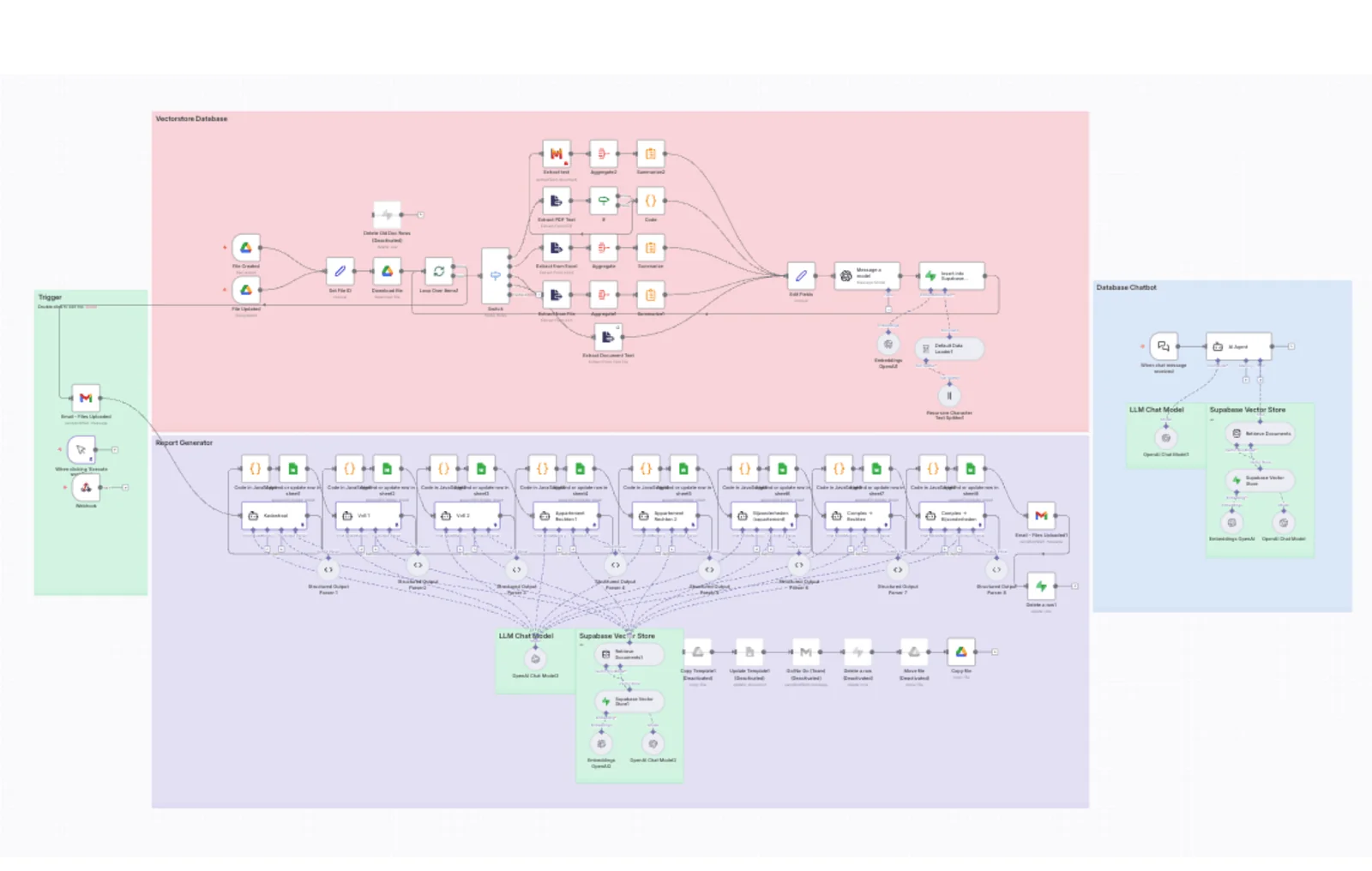
Two design choices from that build apply to most custom agents. One narrow agent per section is easier to test and fix than one long prompt. And structured output turns answers into data a person can compare from one deal to the next. We have not published time-saved or accuracy figures for that client, so we do not claim any.
How much does AI agent development cost?
At the time of writing, a small build of two or three workflows or automations is about $1,000. Larger agent systems get a fixed price after a free strategy call and audit. Model usage is billed to your own provider account on top.
| Cost line | What it is | Who pays whom |
|---|---|---|
| Strategy call and audit | We map the job, the systems and the data, then write a plan and price | Free |
| Small build | Two or three workflows or automations, such as one agent with a few tools | About $1,000, at the time of writing |
| Larger agent system | Several agents, document pipelines, CRM write access, approval steps | Fixed price quoted after the free call and audit |
| Fixes | Anything we built that breaks | Free for 6 months after launch |
| Monthly support | Monitoring, model updates, prompt changes, new tools | Optional, from $200 a month after the 6 months |
| Model tokens | Calls to OpenAI, Anthropic, Google or another provider | Billed by the provider to your account (see the next section) |
| Other software | n8n hosting, a vector database, your CRM plan | Billed by each vendor to your account |
Published "AI agent development cost" ranges from agencies vary by a factor of ten or more, because the word "agent" covers everything from one prompt with one tool to a multi-agent system with compliance review. A price means little until the job, the tools and the volume are written down. That is what the free audit produces.
How much does an AI agent cost to run per 1,000 tasks?
On prices read October 30, 2026, a typical CRM-action agent costs about $2.60 to $54 in model tokens per 1,000 tasks, depending on the model. A heavier research agent costs about $12 to $248 per 1,000 tasks.
Model cost per 1,000 CRM-action tasks
This is our own calculation from the providers' pricing pages (OpenAI API pricing, Anthropic Claude pricing, Gemini API pricing), all read October 30, 2026, standard tier, USD per million tokens. The token counts are assumptions, labelled below. Your agent's real numbers come from the provider's usage logs after the first week.
The assumptions
- Workload A, CRM-action agent (assumption). 4 model calls per task. Each call sends a 3,000-token fixed part (instructions plus tool definitions) and on average 2,000 tokens of conversation and tool results, and returns 300 tokens. Per task: 20,000 input tokens (12,000 of them the repeated fixed part) and 1,200 output tokens. Per 1,000 tasks: 20 million input and 1.2 million output.
- Workload B, research and report agent (assumption). 10 model calls per task, each with a 4,000-token fixed part, 6,000 tokens of retrieved documents and tool results, and 400 output tokens. Per 1,000 tasks: 100 million input (40 million fixed) and 4 million output.
- Arithmetic: (input millions x input price) + (output millions x output price). "With caching" prices the fixed part at the provider's cached-input rate and assumes the cache stays warm. It leaves out cache-write charges, which Anthropic bills separately.
| Model (price in / out per 1M tokens) | Workload A per 1,000 tasks | A with caching | Workload B per 1,000 tasks | B with caching |
|---|---|---|---|---|
| Claude Sonnet 5.5 ($2 / $10) | 20 x $2 + 1.2 x $10 = $52.00 | $29.20 | 100 x $2 + 4 x $10 = $240.00 | $164.00 |
| gpt-6.1-sol ($2 / $10) | $52.00 | $29.20 | $240.00 | $164.00 |
| Gemini 3.1 Pro Preview ($2 / $12) | 20 x $2 + 1.2 x $12 = $54.40 | Not calculated | 100 x $2 + 4 x $12 = $248.00 | Not calculated |
| gpt-6.1-terra ($1 / $5) | 20 x $1 + 1.2 x $5 = $26.00 | $14.60 | $120.00 | $82.00 |
| Gemini 3.8 Flash ($0.75 / $3.75 to Dec 31, 2026) | 20 x $0.75 + 1.2 x $3.75 = $19.50 | Not calculated | $90.00 | Not calculated |
| Claude Haiku 5.5 ($0.10 / $0.50) | 20 x $0.10 + 1.2 x $0.50 = $2.60 | $1.52 | $12.00 | $8.40 |
Cached rates used: $0.10 per million for Claude Sonnet 5.5 and gpt-6.1-sol, $0.05 for gpt-6.1-terra, $0.01 for Claude Haiku 5.5, each from the same pricing pages. Example for Claude Sonnet 5.5, workload A with caching: 12 x $0.10 + 8 x $2 + 1.2 x $10 = $29.20. OpenAI's gpt-6-luna is listed at the same $0.10 / $0.50 as Claude Haiku 5.5, so it lands at the same $2.60.
What the numbers mean for your budget
- The model choice moves cost about twentyfold. The same workload runs from $2.60 to $54.40 per 1,000 tasks. We test the job on a small model first and move up only where the test set shows it is needed.
- Input tokens dominate for agents. Every tool call resends the instructions and history, so input is most of the bill. Caching the fixed part cut workload A by 44% on Claude Sonnet 5.5 in our arithmetic.
- Token counts differ by model. Anthropic states that Claude 4.7 and later models use a newer tokenizer that produces approximately 30% more tokens for the same text. So we compare models on real logged usage from the test set as well as on price per million.
- Prices are dated. Google's page lists Gemini 3.8 Flash at $0.75 / $3.75 through December 31, 2026 and $1.50 / $7.50 from January 1, 2027, which doubles workload A to $39.00. Budgets need a review date.
Which frameworks and models do you build AI agents with?
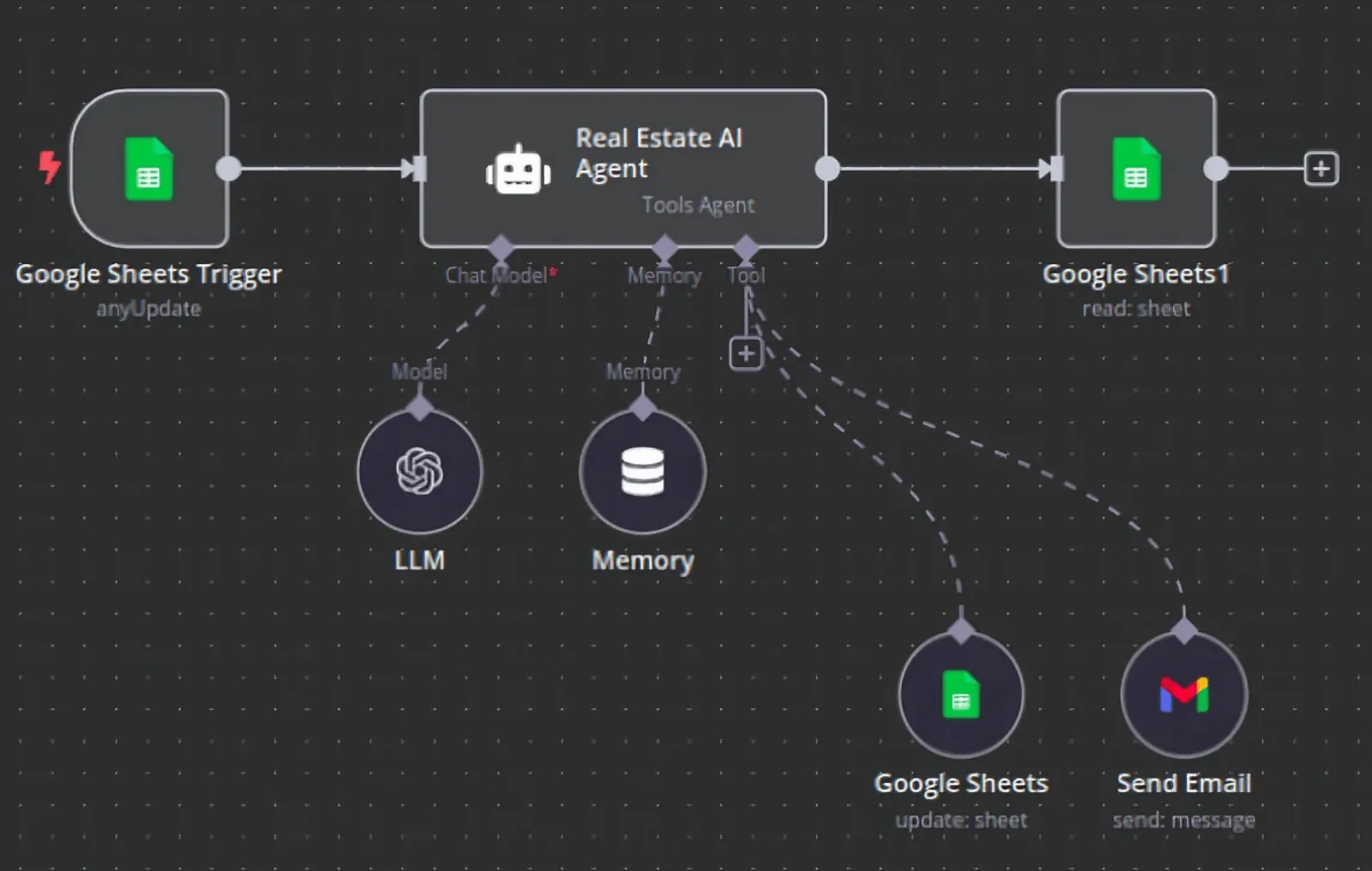
We build on n8n's AI Agent node for most business agents, and in code with the OpenAI Agents SDK, the Claude Agent SDK or LangGraph when the job needs it. Tools connect through APIs or MCP servers.
| Option | What its own docs say it is (checked October 30, 2026) | When we use it |
|---|---|---|
| n8n AI Agent node | An agent node that needs at least one tool sub-node connected; n8n describes an agent as a system that "receives data, makes rational decisions, and acts" | Agents that sit inside business workflows: CRM updates, documents, email, sheets. The team can see every run. |
| OpenAI Agents SDK | "Enables you to build agentic AI apps in a lightweight, easy-to-use package with very few abstractions"; primitives are agents, handoffs or agents as tools, and guardrails | Agents inside a custom app, with handoffs between specialist agents |
| Claude Agent SDK | Gives "the same tools, agent loop, and context management that power Claude Code, programmable in Python and TypeScript" | Agents that work on files, run commands or need permission controls per tool |
| LangGraph | A "low-level orchestration framework and runtime for building, managing, and deploying long-running, stateful agents" | Long-running agents with explicit states, retries and resume points |
| Model Context Protocol (MCP) | "An open-source standard for connecting AI applications to external systems" | Exposing your internal tools and data once, so several AI apps and agents can use them |
For every new build we use current models, never one with an announced retirement date, and pick the model that fits the client's needs for quality, speed, cost and data handling. The framework is chosen per job and written into the plan. A team that wants to watch and edit the agent itself usually gets n8n; our n8n automation services page covers hosting and maintenance. If your agent needs to reach an internal database or app that has no ready connector, we build an MCP server for your internal tools so any compatible agent can use it.
How does the AI agent build process work, and how long does it take?
We map the job on a free call, write the plan and a test set from your real past cases, build in your accounts, test against that set, then launch with a person approving actions. A small build takes days; larger systems get dated milestones.
From free call to a supported agent
- Free strategy call and audit. Which job, which systems, which data, what a correct result looks like, and what the agent must never do.
- Plan and fixed price. The agent's tools, permissions, model, handoff rules and test set, written down before any build starts.
- Build in your accounts. Your n8n, your model provider keys, your CRM. Tools first, then instructions, then the agent loop.
- Test against real cases. The agent runs the test set, and we compare its results with what your team decided by hand.
- Launch with approval. At first a person approves every outside action. Approval is relaxed only for actions that passed consistently.
- Support. Fixes are free for 6 months; monthly support from $200 is optional after that.
How do you test an AI agent before it goes live?
We build a test set of 20 to 50 real past cases with the correct outcome, run the agent on all of them, and check both the answer and the tool calls in the run log. The same set is rerun after every change.
An agent can say it did something without doing it. That is why the run log matters more than the reply: each tool call, its input and its result. Our guide to why an n8n AI agent skips its tools walks through reading that log. What we check on every case:
- Right tool, right inputs. Did it call the lookup before answering? Did it write to the right record?
- Right output shape. Structured output fields are filled and valid, so the next step can trust them.
- Right refusal. On cases outside its job, it hands over instead of guessing.
- Cost and steps. Number of model calls and tokens per case, so the running cost estimate gets replaced with measured numbers.
The test set stays with you. When a provider releases a new model or retires an old one, the set is how we prove the replacement behaves the same before switching.
What guardrails and human handoff does a custom AI agent need?
Give the agent only the tools and permissions its job needs, force answers into fixed fields, cap the steps per run, require approval for anything that sends, pays or deletes, and hand over to a named person when it is unsure.
The frameworks build this in. The OpenAI Agents SDK lists guardrails, checks that validate agent inputs and outputs, as one of its core primitives. The Claude Agent SDK has permissions that control which tools run automatically and which need approval. In n8n we add an approval step before outside actions. The rules we write into every plan:
| Guardrail | What it prevents |
|---|---|
| Least-privilege tools (read-only where possible, separate keys per agent) | An agent changing records it never needed to touch |
| Approval before send, pay, delete or external email | An irreversible mistake reaching a customer |
| Structured output with validation | Free text that the next step misreads |
| Step and spend limits per run | Loops that burn tokens on a failing tool |
| Handoff rule with a named owner and a channel (CRM task, Slack, email) | Unclear cases stalling with nobody told |
| Logging of every run | Not being able to explain what the agent did and why |
Why do AI agent projects fail, and how do you prevent it?
Gartner predicted in June 2025 that over 40% of agentic AI projects will be cancelled by the end of 2027, citing escalating costs, unclear business value or inadequate risk controls. All three are decided during scoping, before a model is chosen.
The prediction comes from Gartner's June 25, 2025 press release; our AI agent adoption statistics page puts it next to the McKinsey and Stanford adoption figures. In day-to-day builds, the failures look like this:
| Symptom | Likely cause | Fix |
|---|---|---|
| Agent says it did something, but nothing changed | Tool never called; vague tool name or description | Name each tool by its job, state when to use it, check the run log |
| Answers drift or contradict the documents | Retrieval returns the wrong passages, or scans were never read | OCR for scans, better chunking, test questions with known answers |
| Monthly bill far above plan | Large model on every step, no caching, long histories resent | Smaller model where tests pass, cache the fixed part, trim history |
| Agent stops working after a provider change | Model retired or an API parameter removed | Watch deprecation notices, rerun the test set on the replacement |
| Team stops trusting it | No way to see why it acted; no handoff on unclear cases | Run logs the team can read, approval step, named handoff owner |
| Nobody can say if it pays off | No baseline measured before launch | Record time or volume per task before the build, then compare |
Who owns the prompts, API keys and data in a custom AI agent?
You do. We build in your accounts: your model provider keys, your n8n or code repository, your CRM and your database. The prompts, tool definitions, test set and run logs are yours, and the whole system runs in accounts you control.
- API keys sit in your provider accounts, billed to your card, so usage costs go directly to you and you can rotate keys at any time.
- Prompts and instructions live in your workflow or repository, versioned, so you can read and change them.
- Data stays in your systems and your chosen providers. Check each provider's data terms for your region; we list every service in the chain in the plan.
- Access for our team is a user you can remove. If you change agencies, the agent keeps working.
Our page on who owns automations and data after a build covers contracts and account transfers in more detail.
What maintenance does an AI agent need after launch?
Agents need regular checks because providers change models, prices and APIs. Plan for model retirements, price changes, removed parameters, and drift in your own data, and rerun the test set before each change goes live.
Three changes on the providers' own pages, all current on October 30, 2026, show why:
- Retirements. Anthropic notified developers on September 30, 2026 that Claude Sonnet 4.5 retires on November 30, 2026, with Claude Sonnet 5.5 as the replacement. After retirement, "requests to models past the retirement date will fail." Anthropic gives at least 60 days' notice for publicly released models (Anthropic model deprecations).
- Removed parameters. Anthropic's API version 2026-10-21 removed temperature, top_p and top_k; setting them returns a 400 error on that version.
- Price changes. Google lists Gemini 3.8 Flash and Gemini 3.6 Flash prices doubling on January 1, 2027.
Fixes to anything we built are free for 6 months. After that, optional monthly support from $200 covers watching notices like these, rerunning the test set, and adjusting prompts and tools as your business changes.
Read next:
- how we test an AI agent before launch
- single agent vs multi-agent systems
- the mistakes AI agents make and who is liable
- which AI models Autoesta uses
More questions about AI agent development
How long does it take to build a custom AI agent?
A small build of one agent with a few tools takes days once access and example cases are ready. A multi-agent system with document pipelines, CRM write access and approval steps takes longer, and the plan after the free audit gives dated milestones. Most delays come from waiting on access, example data and the people who decide what a correct answer is.
What is the difference between an AI agent and an automation?
An automation follows fixed steps you design: when this happens, do that. An AI agent decides some of the steps itself, choosing which tool to call and what to write based on the input. Most good systems mix both. Fixed automation handles the predictable parts, and the agent handles reading, judging and drafting where rules alone would break.
Which AI model is right for an AI agent?
There is no single answer. We run the test set on a small, cheap model first, such as Claude Haiku 5.5 or gpt-6.1-terra, and move up to a larger model only for the steps that fail. On our workload A arithmetic, that choice alone moves running cost from about $2.60 to $54 per 1,000 tasks on October 30, 2026 prices.
Can an AI agent update our CRM by itself?
Yes, through the CRM's API, with permissions limited to the fields and actions the job needs. We usually start with the agent drafting updates and a person approving them, then let it write directly once the test set and the first weeks of real runs show it gets those updates right. Every change it makes is logged.
Can we use our own OpenAI, Anthropic or Google API key?
Yes, and we recommend it. The agent runs on keys in your own provider account, so usage is billed to you at the provider's list price with no markup from us, you see the usage dashboard yourself, and you can rotate or revoke the key at any time. Our build and support prices are separate from token costs.
Is building an AI agent worth it for our business?
It is worth it when one job repeats often, takes real staff time, and has a clear correct answer someone can check. Measure the time or volume per task before the build, then compare after launch. If a job happens a few times a month, a checklist or a simple automation is often the better spend.
Do you build multi-agent systems?
Yes, when the job splits into sections that each need their own search and answer. The Dutch property report build uses eight agents, each filling one report section with fixed fields. Several narrow agents are easier to test and fix than one large prompt, but each extra agent adds model calls, so we only split where testing shows it helps.
Can you fix or take over an AI agent another developer built?
Yes. We start with the free audit: we read the workflow or code, the prompts, the tool definitions and recent run logs, then list what is broken and what it costs to fix. If the agent runs in accounts you own, we can work on it directly. If it runs in the old developer's account, moving it is the first step.
Are you an AI agent development company in the USA?
Autoesta is a 16-person team with about 8 people in San Francisco and the rest in India and Nepal. We build for companies in 15+ countries, including the United States, United Kingdom, Canada, Australia and the UAE, and we have delivered 320+ projects. Calls are booked online at a time that suits your time zone.
Will an AI agent replace our staff?
The agents we build take over the repeated reading, sorting and drafting inside a job, and hand anything unclear or irreversible to a person. In practice that frees staff time for the parts of the job that need judgment. We agree the handoff rules with the people whose work changes, before launch, so they know exactly which tasks the agent does.
Sources and further reading
- OpenAI API pricing, checked October 30, 2026
- Anthropic Claude pricing, checked October 30, 2026
- Google Gemini API pricing, checked October 30, 2026
- Anthropic model deprecations, checked October 30, 2026
- What is the Model Context Protocol (MCP)?, checked October 30, 2026
- OpenAI Agents SDK documentation, checked October 30, 2026
- Claude Agent SDK overview, checked October 30, 2026
- LangGraph overview, checked October 30, 2026
- n8n AI Agent node documentation, checked October 30, 2026
- Gartner: over 40% of agentic AI projects will be canceled by end of 2027, June 25, 2025