What makes a real GoHighLevel expert, not just a template reseller?
A real GoHighLevel expert can explain how your account is built, why a workflow triggers the way it does, and what to fix when something breaks. A template reseller installs a pre-built snapshot and hands you a login.
This guide is about vetting. If you already want help, our GoHighLevel expert service starts with an audit of your account.
That distinction shows up fast once you ask a follow-up question. A real expert can open your pipeline, point at a specific automation, and tell you what happens when a contact re-enters it. A reseller who only imported a snapshot usually can't, because they never built the logic, they only clicked "import."
- A real expert reads your existing account before proposing anything, the way we do on every audit call.
- A real expert can name the specific trigger, filter, or integration causing a problem, whether that's a native app or an n8n workflow instead of suggesting "rebuild it."
- A reseller's answer to most questions is "that's just how the template works" or a link to GoHighLevel's own help center.
- A real expert has a checkable credential and a specific account history, not a stock photo and a generic bio.
What does a GoHighLevel template reseller actually sell you?
A template reseller sells a pre-built snapshot of pipelines, workflows, and funnels that someone else designed, imported into your account with minimal customization.
This isn't automatically a scam. Snapshots exist inside GoHighLevel for a reason: they save real setup time, and a well-made one can be a fine starting point for a simple funnel. The problem is when a snapshot is sold as a custom build, priced like one, and the person selling it can't explain what's inside it or adjust it when your business doesn't fit the template's assumptions.
The tell is usually in how quickly the "build" happens. A custom pipeline that matches how your team actually sells, with the follow-up logic tuned to your lead sources, takes real time to configure and test. A snapshot import takes an afternoon, because most of the work happened once, for someone else's business, months ago.
What technical questions separate a real expert from a reseller?
Ask about A2P 10DLC registration, duplicate contact handling, workflow re-entry conditions, and what happens when an integration silently fails. A real expert answers all four without pausing.
Four questions that separate experts from resellers
These are not trick questions. They're the specific, boring details that only surface after someone has actually launched and maintained live accounts.
- A2P 10DLC registration. In the United States, businesses must register their brand and campaign before SMS reliably delivers through most CRMs, GoHighLevel included. Someone who has launched real accounts will discuss this without prompting, because it's one of the most common reasons a new client's texts silently stop sending. Anyone who has never heard the term has not run a real US SMS setup.
- Duplicate contact handling. Bad imports and multiple lead sources create duplicate records constantly. A real expert has a specific merge or dedupe process; a reseller usually hasn't thought about it because their template account never had real client data flowing through it.
- Workflow re-entry conditions. Ask what happens if the same contact re-enters an automation twice. A real expert can describe the re-entry setting and why they chose it. This is exactly the kind of silent failure that causes double-texting or a contact getting stuck.
- Integration failure handling. Ask what happens when a Zapier, n8n, or native integration stops syncing. A real expert has a monitoring habit or an answer beyond "it usually just works."
If someone selling GoHighLevel "expertise" can't hold a two-minute conversation about any of these, they've likely never had to fix them under pressure, which is most of what the job actually is.
Does a HighLevel certification prove someone is a real expert?
A HighLevel certification proves platform literacy, meaning the person has studied how the software works. It does not prove they can design a system for your specific business, so treat it as one checkable signal, not the whole answer.
It's still worth asking for, because it's one of the few things you can actually verify instead of taking on faith. Autoesta's founder, Alpit Patel, is a HighLevel Certified Admin, and the credential carries a real ID you can ask him to confirm.
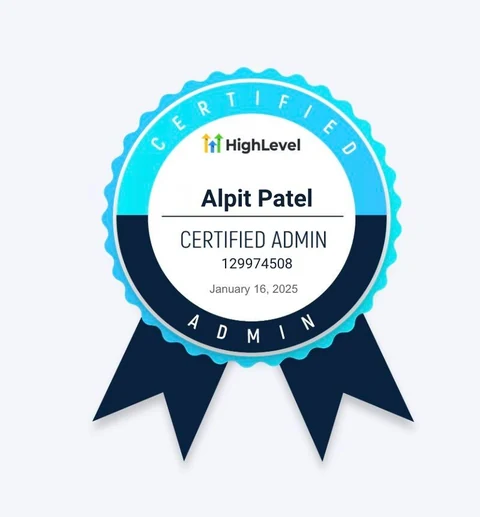
A certification like this tells you someone passed HighLevel's own assessment of the platform. It does not tell you whether they've built for a business like yours, whether they communicate well, or whether their judgment on a messy real account is any good. Ask for the certification and for examples of accounts they've actually built or fixed. One without the other is an incomplete picture.
What should a real GoHighLevel expert ask you before touching your account?
A real expert audits your account and your lead flow before quoting anything. If someone gives you a fixed price before looking at what already exists, that price is a guess.
On a first call, expect to be asked more than you're told. The questions that matter:
- How many leads do you get in a typical week, and where do they come from?
- What's your current first-response time, and who's responsible for it?
- What's already built in your GoHighLevel account, and what were you told it does?
- Which other tools are you paying for that this account should replace or connect to?
This is the same order we work in: an audit before a quote, because a fix scoped after seeing what's actually broken costs less than a rebuild priced sight unseen. See how a GoHighLevel expert audit works for the specifics of what that first call covers, or our full guide to hiring a GoHighLevel expert in the US for the end-to-end process, from where to look to what to put in writing.
What are the red flags when vetting a GoHighLevel consultant?
The clearest red flags are a fixed quote given before any audit, no mention of A2P 10DLC when SMS is part of the build, and an inability to describe what's currently in your account.
Red flags when vetting a GoHighLevel consultant
| Red flag | Why it matters |
|---|---|
| Fixed price quoted before seeing your account | They're pricing a guess, not your actual setup. Scope and price should follow an audit, not precede it. |
| No mention of A2P 10DLC when SMS is involved | Suggests they haven't launched a real US account with texting, or don't know why messages silently fail. |
| Can't describe what's already in your account | A real audit produces specific findings. A vague "it needs a rebuild" with no detail is a sales line, not a diagnosis. |
| Sells "unlimited revisions" with no scope | Unlimited anything with no defined scope usually means the initial build was rushed and revisions are how they fix it later, on your time. |
| No verifiable credential or account history | A stock bio photo and no certification ID, portfolio, or reference you can check is a sign there's nothing to check. |
What should a real GoHighLevel expert do after the account is built?
A real expert stays responsible for what they built. Ask directly what happens if a workflow breaks the week after launch, and get the answer in writing.
This is where a lot of "expert" engagements quietly end: the account gets handed over, the invoice gets paid, and support stops. Ask specifically whether testing, bug fixes, and documentation are included, for how long, and what counts as their responsibility versus a new request you'll be billed for separately. Autoesta includes six months of maintenance on everything we build, covering fixes to the workflows, pipelines, and integrations we delivered; it does not cover new features or changes to third-party platforms we didn't build. Whatever the specific terms are with whoever you hire, get them before you sign, not after something breaks.
When is a template reseller actually the right choice?
A template or snapshot reseller is a reasonable choice for a single, simple funnel with no custom logic and a small budget, where getting something live cheaply matters more than a system tuned to your exact sales process.
If you're testing an offer with one lead source and one follow-up sequence, a decent snapshot can get you moving in a day for a fraction of a custom build's cost. The tradeoff is real: you're accepting someone else's assumptions about pipeline stages, follow-up timing, and messaging, and you'll likely outgrow it the moment you add a second lead source or a more complex sales process. A custom build, the kind a GoHighLevel setup agency does from scratch, or a real expert's fix to an existing account, earns its cost once your sales process is too specific for a generic template. Know which situation you're in before you decide who to hire.
To turn these questions into a score you can compare across candidates, see how to shortlist GoHighLevel experts.
What does this look like once it's actually built?
A real GoHighLevel build is judged by whether it holds up under real lead volume, not by how it looks in a demo.
Our dental CRM automation case study shows one example: a practice that moved from scattered, manually answered enquiries to a single pipeline with automated intake and response. See more examples in our case studies, and judge any expert you're considering the same way: ask to see something they actually built, not a description of what they could build.