How do you hire a GoHighLevel expert in the US?
Find candidates in a place you can check, vet them on a live call with specific questions, compare their price against published market ranges, and get scope, support period and account ownership in writing before you pay. The safest first purchase is an audit or a scoped review, not a fixed quote given without anyone looking at your account.
Five steps to hiring well
To see what hiring us looks like, read the GoHighLevel expert service page, then compare it against the checklist below.
Most people who search for this are stuck between two bad options. Build it yourself and hope, or hand it to whoever replied fastest on a freelance marketplace. Neither is necessary. The process is the same whether you need a small fix or a full build.
- Decide what you are hiring for. Fix an existing account, build a new one, or keep one running. These are different jobs (see the section on expert versus setup agency below).
- Build a short list from places you can verify. Certified directory, referrals, agencies with published work.
- Run a vetting call. Use the questions later in this guide, and ask to see something they built.
- Compare price and deliverables, not price alone. A cheap audit that returns two lines of advice costs more than a fair one that returns a fix plan.
- Sign a written scope. Price, support period, documentation and who owns the account.
This guide is written for a business owner or operations lead in the US. We run Autoesta, a GoHighLevel agency, so we are one of the options you might weigh. Where we describe our own process or prices we say so, and where we cite market prices they come from other published sources, not from us.
Where do you find a GoHighLevel expert in the US?
Start with HighLevel's own Certified Admin directory, referrals from other GoHighLevel users, and specialist agencies that publish real work. Use marketplaces like Upwork for small, low-risk jobs, and treat every claim there as unverified until a live call confirms it.
- The HighLevel Certified Admin directory. HighLevel says certified professionals are listed in a Certified Admin directory that clients can browse. Its certification page describes coursework and a live proctored exam. That makes it a useful first filter. It is not proof that someone has handled an account like yours.
- Referrals from other GoHighLevel users. This is the strongest signal available, because someone who already paid for the work can tell you what broke and how the person responded afterwards. Ask in the communities you already belong to, and ask the referrer what went wrong, not only what went well.
- Specialist agencies. Look for named people, a checkable credential, published case studies and an audit before a quote. The advantage of an agency is that a business is accountable, not only one person.
- Marketplaces such as Upwork and Fiverr. Reasonable for one simple funnel or a short fix. Portfolios can show work the seller did not do, so ask for a walkthrough on a call.
- Independent directories and community groups. Useful for discovery, but check how a listing is verified. If the answer is "it is not," treat it like a marketplace.
Whichever source you use, the vetting steps below apply the same way. A polished listing tells you nothing about whether the person can explain your account once it is live.
Does the expert need to be near you?
No. GoHighLevel work is done remotely in a browser, so location matters far less than time-zone overlap, US compliance knowledge and how quickly someone answers. Being in your city only helps if you want in-person training for a team.
A lot of people search for a GoHighLevel expert near them out of habit, the way they would look for a plumber. The work does not need a site visit. What does matter for a US business:
- Working-hours overlap. If leads arrive during your day and something breaks, you want someone reachable during it. Ask what hours they are online and what their response time is for a broken workflow.
- US messaging rules. Texting US customers from a standard 10-digit number requires A2P 10DLC registration, per HighLevel's own support documentation. Someone who has done that registration in the US will know what the carriers look for. Registration and consent rules are compliance topics, so treat anything here as general information, not legal advice, and have counsel review consent wording for your industry.
- A US entity to contract with. Easier invoicing, clearer contracts, and a business you can find if a dispute arises.
Our own team is split: about eight people in San Francisco and the rest in India and Nepal. We have worked with clients in more than 15 countries. If you are outside the US, for example in Dubai or the UK, the same hiring steps apply. The A2P point is US-specific, so ask any candidate what messaging registration your region requires.
What should you look for when vetting a GoHighLevel expert?
Look for someone who audits before quoting, can explain a workflow in plain English, holds a credential you can check, and answers pricing and support questions directly. Those four hold up across every project size.
- They ask before they quote. A price given before anyone has looked at your account, your lead volume or your current setup is a guess dressed as a number.
- They can walk you through a build in plain English. Ask them to describe how a lead moves through a pipeline they built. If they can explain the trigger, the filter and what happens when the same contact re-enters, they built it. If they point you to HighLevel's help articles, they may have imported it.
- They hold a credential you can check. A badge image on a website proves nothing. A certification ID, a directory listing or a past client you can call does.
- They answer pricing and support questions directly. "It depends on scope, here is how we scope it" is a real answer. "Trust me, we will figure it out" is not.
The best move costs nothing. Ask to see one account they built or fixed, with client data hidden, and ask them to explain one automation inside it. Watching someone talk through their own work is harder to fake than any portfolio page.
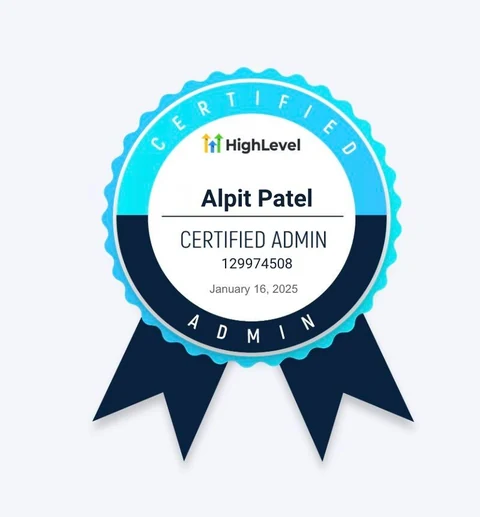
A word on certification. HighLevel's certification page says the coursework takes roughly 7 to 10 days and that a live proctored exam must be passed. It also says certified people keep their status through a paid subscription, at $97 a month or $970 a year at the time of writing. So a valid certificate means someone passed an exam and stays current with the platform. It does not tell you whether they can untangle a five-year-old account. Our founder, Alpit Patel, is a HighLevel Certified Admin (ID 129974508, issued January 16, 2025), and even so we would tell you to test us on the questions in this guide.
How do you tell a real expert from a template reseller?
Ask about A2P 10DLC registration, duplicate contact handling, workflow re-entry, and what happens when an integration fails. A real expert answers all four without pausing. A template reseller usually cannot, because they imported a snapshot instead of building the logic.
That test deserves more space than a section of a hiring guide can give it. Our companion post, what makes a real GoHighLevel expert, not a template reseller, walks through each of the four questions and the signs that show up once an account is live. Read it before your vetting call if you want to pressure-test technical depth. Here we stay on the hiring process itself.
Freelancer, agency or offshore VA: which should you hire?
Hire a freelancer for one bounded project with a fixed end date, an agency for anything with integrations, compliance or business risk if it breaks, and an offshore VA only for documented, repetitive maintenance under supervision.
| Option | Best for | Watch out for |
|---|---|---|
| Independent US freelancer | One funnel, one automation, or a specific fix with clear scope | No backup if they get busy or disappear; support after launch is often informal |
| Specialist agency | Full setups, multi-location or white-label builds, ongoing support, anything costly to break | Higher upfront cost; confirm you will talk to the person who builds, not only a salesperson |
| Offshore GoHighLevel VA | Updating contact lists, duplicating an existing funnel, repeating a documented task | Weak fit for original design or diagnosing a broken automation, since the work depends on someone else's instructions |
One structural difference is worth knowing. A freelancer is a single point of failure: if they are ill or leave for a full-time job, your knowledge of the account leaves with them. A team spreads that risk, which is the main reason we work as a team of 16 rather than as one consultant. It is also why an agency is not automatically better. A one-person specialist with a good reference can beat a large agency that hands you to a junior.
How much does it cost to hire a GoHighLevel expert?
At the time of writing, published market guides put freelance GoHighLevel rates at roughly $25 to $75 an hour, with top US specialists at $75 to $150, and full account setups from about $300 up to $4,000 or more. Autoesta's audit is free, cleanup work starts from $200, and a full setup is $3,000 to $5,000.
Autoesta engagement starting prices
Two different sets of numbers follow, and they should not be mixed. The first table is Autoesta's own price list. The second is market context from other published sources, useful for sanity-checking any quote, including ours.
| Autoesta engagement | What it covers | Typical starting price |
|---|---|---|
| Account audit | Review of an existing account, written findings, prioritized fix plan | Free |
| Account cleanup or verification | Fixing a messy account, or verifying one that already works | From $200 |
| Small automation build | Two to three automations connected to your CRM | From about $1,000 |
| Full GoHighLevel setup | Pipelines, workflows, calendars, messaging, integrations, reporting, training | About $3,000 to $5,000 |
| White-label build | A branded system an agency can resell to its own clients | $5,000 to $7,000 |
| Multi-location build | Five or more locations or sub-accounts with shared standards | $5,000 to $10,000 |
| Monthly support | Ongoing changes after launch | From $200 per month |
Those are Autoesta's prices at the time of writing, and the setup detail lives on our GoHighLevel setup page. Six months of maintenance is included on builds. The audit is paid, not free. What is free is the first 30-minute strategy call, where we decide whether an audit is even the right step.
| Market figure | Range at the time of writing | Source |
|---|---|---|
| Offshore VA hourly | $3 to $16 an hour | GHL Ops guide, July 2026 |
| Freelance expert hourly | $25 to $75, top US specialists $75 to $150 | GHL Ops guide, July 2026 |
| Full account setup, one time | $300 to $1,000 basic, $1,000 to $4,000 full, $10,000 or more for snapshot-heavy builds | GHL Ops guide, July 2026 |
| Setup by tier | $500 to $1,500 basic, $1,500 to $5,000 standard, $5,000 to $15,000 or more advanced | GHL Logic guide, July 2026 |
| Ongoing management | $300 to $2,000 or more a month | GHL Logic guide, July 2026 |
These come from two vendor guides: GHL Ops, which sells managed GoHighLevel support, and GHL Logic. Both are commercial sites, and the GHL Ops figures are drawn from published pricing pages and marketplace listings rather than a survey. Read them as directional, not as a price index.
Two more things to know before you compare quotes. First, audit prices vary a great deal. GHL Ops lists account audits at $1,500 to $5,000, while ours are free, and GHL Logic gives no audit price at all. The number tells you little until you ask what you receive: a written findings list, a ranked fix plan, and whether the fee is credited if you hire the same team to do the fixes. Second, all of the above excludes HighLevel's own subscription, which you pay separately. Our GoHighLevel pricing breakdown covers the current tiers.
What should you ask on the first call?
Ask about your lead volume and response time, what already exists in your account, which other tools it should replace or connect to, and exactly what happens if something breaks after launch. A real expert asks most of these before you do.
This is close to the structure of our own strategy call, because scoping a fix or a build without this information means guessing. Ask them of every candidate, and notice which ones ask you first.
- How many leads do you get in a typical week, and where do they come from?
- What is your first-response time today, and who owns it?
- What is already built in the account, and what were you told it does?
- Which other tools are you paying for that this should replace or connect to?
- What happens if a workflow breaks the week after launch, and is that covered or billed separately?
- Can I see one account you built or fixed, and can you walk me through one automation in it?
- Will the person on this call be the person doing the work?
Then ask them what they would check first if they had ten minutes in your account. A good answer names specific things: SMS registration status, the trigger on your main workflow, whether test contacts appear twice. A weak answer offers generalities about "optimizing your funnel." If a candidate names a price before asking anything from the list above, you have seen the fixed-quote-before-audit problem in practice.
What should a signed engagement include?
A written scope of what will be built or fixed, a price tied to that scope, a stated support period after launch, clarity on who owns the GoHighLevel account and its data, and documentation of what was built.
- Scope. A specific list of what is being built or fixed, not "set up my CRM."
- Price and payment schedule. Tied to the scope, with milestones for anything beyond a small fix.
- Support period. How long fixes are covered, and what counts as a bug versus a new request. We include six months of maintenance on everything we build. It covers fixes to the workflows, pipelines and integrations we delivered. New features, and changes on third-party platforms we did not build, are scoped and billed separately.
- Account ownership. The GoHighLevel account and subscription should stay in your name, not sit inside the contractor's agency account, so you are never locked out if the relationship ends. Ask this before you sign.
- Access and credentials. Who has admin access during the work, and a promise to remove or downgrade it when the project ends.
- Documentation. A short written record of what each pipeline stage, workflow and integration does, so a future hire does not start from zero.
- Compliance responsibility. Who is responsible for consent wording and message registration. Your lawyer, not your contractor, decides what is legally sufficient for your business.
What are the red flags that mean walk away?
The clearest red flags are a fixed price before any audit, no mention of A2P 10DLC when texting is part of the build, an inability to describe what is in your account, and no credential or reference you can verify.
| Red flag | Why it matters |
|---|---|
| Fixed price before seeing your account | They are pricing a guess, not your setup |
| No mention of A2P 10DLC when SMS is involved | Registration is required for US texting from standard local numbers. Someone who skips it has probably not launched a US account with texting |
| Cannot describe what is already in your account | A real audit produces specific findings, not a vague "it needs a rebuild" |
| "Unlimited revisions" with no defined scope | It often means the first build was rushed and revisions are how they fix it later, on your time |
| Wants the account in their agency login | You could lose access to your own contacts and history if the relationship ends |
| Nothing you can independently check | No certification ID, no reference, no real client work to look at |
| Guarantees a specific revenue or lead result | A contractor controls how the system is built, not how many people buy from you |
One failure to ask about: texts that show as sent in the conversation view but never reach the phone. In our audits we check SMS registration status first for this reason. It is the kind of failure nobody notices until leads stop replying, which is why a hiring call that never touches messaging should worry you.
Should you hire a GoHighLevel expert or a full setup agency?
Hire an expert to audit and fix an account that exists and mostly fits how you sell. Hire a setup agency when you are starting from nothing, or when the structure no longer matches your business and needs rebuilding, not patching.
The two jobs are often sold under the same title, so ask which one you are buying. If your pipeline stages, automations and integrations are basically sound and something specific is misconfigured, audit-and-fix is faster and cheaper. If you have never had GoHighLevel set up, or three freelancers have patched the account over the years until nobody can trace a lead's path through it, a fresh build from a GoHighLevel setup agency is the honest answer, even though it costs more up front. Our guide to fixing a messy GoHighLevel account shows how to tell which situation you are in, and how to set up GoHighLevel properly lays out the build order for a new account.
When is hiring a GoHighLevel expert the wrong choice?
Do not hire an expert when your account is small and healthy, when you have not decided how you want to sell, or when GoHighLevel itself is the wrong tool. Paying someone to automate a process you have not defined only makes the confusion run faster.
- You have not defined the process. If nobody can say what should happen to a lead after they fill in a form, an expert will invent an answer and you will pay to change it later. Write the steps on one page first.
- The fix is an afternoon of your own time. A single broken calendar link or a missing tag can often be solved from HighLevel's help center. Our GoHighLevel expert page lists checks you can run yourself before paying anyone.
- Your problem is the offer, not the software. If leads arrive and do not buy, no automation fixes that. An audit sometimes ends with us saying so.
- Another platform fits better. If you need deep enterprise reporting, or your team will not maintain a flexible system, see our GoHighLevel and HubSpot comparison before you spend anything on a build.
- The budget is a few hundred dollars for a big build. Market guides list basic setups from about $300 and full setups from about $1,000, so a low bid for a large scope deserves a hard look at what it leaves out.
Autoesta is also the wrong fit in some cases. If you need someone at your office for in-person team training, or a one-hour fix you could buy from a marketplace for less than our $200 cleanup minimum, a local freelancer or a marketplace listing will serve you better. We say so on the free call.
Once you have a few candidates, use our scorecard for comparing GoHighLevel experts to rank them on the same criteria.
Where does Autoesta fit in all of this?
Autoesta is a specialist agency: a free 30-minute call to understand your lead flow, a free audit if you have an existing account, a written scope and price before anything is built, then the build and six months of included maintenance.
We have run this way since 2021, and the team has delivered more than 320 projects across 15-plus countries. We do not quote before we have seen what exists, because a fix scoped after an audit costs less than a rebuild priced blind. The audit itself is described on our GoHighLevel expert page, including the fifteen areas it covers and what you receive at the end.
Here is what that looks like in practice. The audit ends in a written, ranked list of what is broken and why. From that list you get one of two things: a scoped quote to fix the specific items, or a recommendation to rebuild the structure while keeping your contact data. You know which one you are buying before you pay for either, and nothing is bundled that you did not ask for.
If you want evidence rather than description, our dental CRM case study and real estate case study show finished builds, with results reported by Autoesta and clearly labeled as such. Our other case studies are listed in one place. When a job needs a tool beyond GoHighLevel's native automations, such as a system-to-system sync, we use n8n automation alongside it, and our AI automation services cover voice and chat agents. Founder Alpit Patel is the certified admin behind the team.
Looking for a GoHighLevel expert who knows your industry? We have dedicated pages for a GoHighLevel expert for med spas, GoHighLevel for real estate teams, GoHighLevel for HVAC companies, GoHighLevel for dentists and GoHighLevel for weight loss clinics. Each one covers the setup, the software it connects to and the rules that apply in that industry. See all of them on the GoHighLevel by industry page.
You do not have to hire us. The questions in this guide work on any candidate, including us. If you use them and end up with someone else, that is a good outcome for you.