What makes someone one of the best GoHighLevel experts in the USA?
The best GoHighLevel expert is the one who scores highest on evidence you can check for your kind of project: comparable work, an audit-first process, technical depth on failure points, clear terms and reachable people. No public ranking can tell you that for your account.
If you would rather skip the shortlist, see what our GoHighLevel expert service covers and use this scorecard on us too.
Searching "best GoHighLevel experts" usually turns up lists with a number in the title. Many of those lists are written by companies that appear on them, and none can know your industry, your lead volume or the state of your account. So this page does something different. It gives you a scorecard, shows you how to use it, and gives a fair overview of where to find candidates so you can build a shortlist of three to five.
A disclosure before anything else. We run Autoesta, a GoHighLevel agency, so we are one of the options you might weigh. We do not rank named competitors here, and we do not invent ratings for anyone, including ourselves. Where we describe our own credentials, we say what you can verify and what you cannot verify from this page.
This page is the "shortlist and compare" step. If you are further along and need the hiring process, pricing ranges and contract terms, read how to hire a GoHighLevel expert in the US. If your worry is template resellers, see what makes a real GoHighLevel expert.
What should you score when comparing GoHighLevel experts?
Score every candidate from 0 to 5 on eight criteria, multiply each score by its weight, and add the results for a total out of 100. The weights put comparable work, audit-first process and technical depth ahead of credentials and price.
How the scorecard weights each criterion
The weights below are our own judgment, built from the failures we see when we audit accounts other people built. They are not an industry standard. Change them if your situation is different: a regulated clinic should raise compliance, an agency reselling a white-label build should raise support and ownership terms.
| Criterion | Weight | Score 5 looks like | How you check it |
|---|---|---|---|
| 1. Checkable identity and credentials | x2 | A named person, a certification ID or directory listing, a business you can look up | Search the directory, ask for the ID, find the business online |
| 2. Proof of comparable work | x4 | They walk you through a build or fix similar to yours, with client data hidden, and explain one automation in it | Live screen share on a call; a reference you can contact |
| 3. Audit before quote | x3 | They ask about lead volume, current setup and response time before naming a price | Notice what they ask on the first call |
| 4. Depth on failure points | x3 | They discuss A2P registration, duplicate contacts, workflow re-entry and silent integration failures without prompting | Ask what they would check first in ten minutes inside your account |
| 5. Scope and price clarity | x2 | A written scope tied to a price, with milestones, and a clear line between fixes and new requests | Ask for a sample scope or proposal |
| 6. Support and ownership terms | x2 | Account and subscription in your name, documentation delivered, a stated support period | Read the terms before signing |
| 7. Compliance handling for your industry | x2 | They know US texting registration and consent basics, and tell you when a lawyer must decide | Ask what they did for a client in your industry; this is not legal advice |
| 8. Communication and availability | x2 | Overlapping working hours, a stated response time, and the person on the call is the person doing the work | Ask directly, and time their replies during the sales process |
The weights add up to 20, so a perfect score of 5 on everything gives 100. Criterion 2 carries the most weight because it is the hardest to fake. A polished website costs nothing to build. Explaining your own build on a live screen share is much harder to fake.
One rule sits on top of the arithmetic. Treat a score of 0 or 1 on criterion 2, 3 or 6 as a stop, whatever the total says. A candidate with no comparable work, no audit step or no ownership terms can still land a decent total on charm and price. Those three gaps are the ones that cost you the most later.
How do you use the scorecard to build a shortlist?
Collect five to eight candidates from at least two different sources, run one 30-minute call with each, score them the same day, and keep the top three. Scoring right after the call matters, because memory drifts toward whoever was friendliest.
Worked example: two candidates scored
- Write down your job first. Fix an account, build a new one, or keep one running. Scores only mean something against a defined job.
- Pull candidates from two source types. For example the official directory plus a referral, so no single listing model controls your shortlist.
- Use the same call script for everyone. The question list in our hiring guide works well. Identical questions make the scores comparable.
- Score alone, straight after each call. Give a 0 to 5 for each criterion and write one sentence of evidence next to each number. A score with no evidence is a feeling.
- Apply the stop rule, then rank by total. Drop anyone under the stop rule. Rank the rest.
- Ask the top two for a paid, small first step. An audit or a scoped review is a better tiebreaker than any score.
Here is what a worked example looks like. These two candidates are hypothetical. They are not real providers, and the numbers are made up to show the arithmetic. Illustrative example. Not client data.
| Criterion (weight) | Candidate A, score | Candidate A, points | Candidate B, score | Candidate B, points |
|---|---|---|---|---|
| 1. Identity and credentials (x2) | 4 | 8 | 5 | 10 |
| 2. Comparable work (x4) | 3 | 12 | 5 | 20 |
| 3. Audit before quote (x3) | 5 | 15 | 2 | 6 |
| 4. Failure-point depth (x3) | 4 | 12 | 3 | 9 |
| 5. Scope and price (x2) | 3 | 6 | 4 | 8 |
| 6. Support and ownership (x2) | 4 | 8 | 2 | 4 |
| 7. Compliance (x2) | 2 | 4 | 3 | 6 |
| 8. Communication (x2) | 5 | 10 | 3 | 6 |
| Total | 75 | 69 |
Candidate B has the stronger credentials and the better portfolio, yet finishes lower. B quoted a price before asking about the account and has thin ownership terms. Candidate A has the weaker portfolio, but works in the order that protects you. The scorecard's job is to surface that trade-off in numbers before you sign, not to pick a winner automatically.
A rough reading of the total: 80 or above is a strong candidate, 65 to 79 is workable if the weak rows are fixed in writing before you start, and below 65 is a pass. Treat the bands as a starting point, not a law.
What kinds of GoHighLevel experts can you choose from?
You can choose HighLevel's own certified directory, specialist agencies, independent freelancers, marketplace sellers, offshore assistants or community referrals. Each has a different strength, and none is best for every job.
| Provider type | Where it shines | What to check | Criteria it tends to score well on |
|---|---|---|---|
| HighLevel Certified Admin directory | A first filter: listed people have completed HighLevel's coursework and a live proctored exam | Certification confirms platform knowledge, not delivery quality or communication | 1 |
| Specialist agencies | Full builds, multi-location work, ongoing support, anything costly to break; a business is accountable | Whether you speak to the person who builds; higher upfront cost | 3, 5, 6, 8 |
| Independent freelancers | Bounded projects and specific fixes; often senior people working directly | Backup if they are ill or busy; informal support after launch | 2, 8 |
| Marketplace sellers (Upwork, Fiverr) | Small, low-risk tasks with a clear deliverable | Portfolios can show work the seller did not do; ask for a live walkthrough | Varies widely |
| Offshore assistants | Repeating a documented task, updating lists, duplicating an existing funnel | Weak fit for original design or diagnosing a broken workflow | Usually 8 only |
| Community referrals | The best evidence available: a past client tells you what broke and how it was handled | Ask what went wrong, not only what went well | 2, 6 |
The last column is a tendency, not a rating of any real company. An excellent freelancer can score 5 on every criterion, and an agency can score 1 on several. Use the type as a starting hypothesis and let the scorecard decide.
Two points about lists you may find elsewhere. First, a list of "places to hire" written by an agency often includes that agency in the final category. That is normal and not dishonest, but it is a reason to read such lists as marketing plus information, and it applies to this page too. Second, a directory listing tells you someone is findable. It does not tell you whether their last client was happy.
What does HighLevel certification and its directory prove?
A HighLevel certification shows that someone completed HighLevel's training and passed a live proctored exam, and that they currently hold an active HighLevel subscription. It does not prove they can rescue a five-year-old account or communicate well with you.
HighLevel describes its certification on its own certifications page. At the time of writing, the details are:
- Coursework is designed to be completed in about 7 to 10 days at a steady pace.
- A live proctored exam must be passed to earn the credential.
- The subscription that keeps certification active is $97 a month or $970 a year. If it ends, HighLevel says the certification becomes inactive and the person is removed from the directory.
- Certified professionals are listed in the HighLevel Certified Admin Directory, where clients can find them.
- The badge is valid for two years from the exam date, and certified people must earn at least two additional skills badges a year. HighLevel names A2P, AI and HIPAA among the specialized badges.
That last detail is useful in the scorecard. A current skills badge in A2P or HIPAA is a checkable signal for criterion 7, more specific than the base credential. Since badges expire and subscriptions lapse, ask a candidate when they passed and whether their listing is active today. We say the same about ourselves. Founder Alpit Patel holds the HighLevel Certified Admin credential, ID 129974508, issued January 16, 2025, and you should ask him for the current status like you would for anyone else.
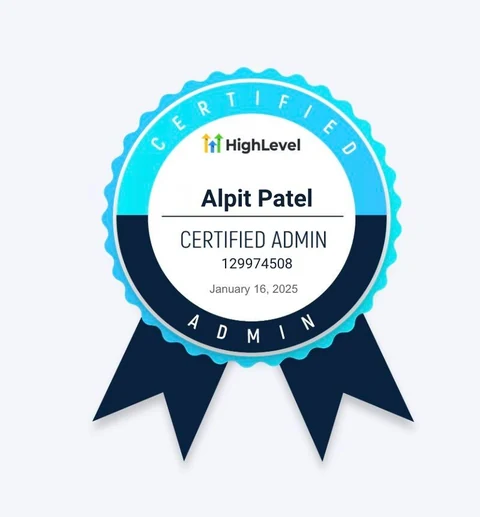
Read plainly, certification is worth a moderate score on criterion 1 and nothing at all on criteria 2 to 8. Someone can hold it and still fail every other row, and someone excellent may never have paid for it.
How do you verify a provider's claims in ten minutes?
Look up the person in the directory, ask for a certification ID, request one walkthrough of a real build, and search for the business outside its own website. Those four steps take about ten minutes and expose most weak candidates.
- Search the name in the directory. Confirm the listing exists and matches the person you spoke to, not only the company name.
- Ask for the certification ID and the exam date. A real credential has both. A badge image alone proves nothing.
- Ask for a screen-share walkthrough. Have them open a real account, with client data hidden, and explain one automation: trigger, filter, and what happens if the same contact re-enters.
- Ask what they would check first in your account. Good answers name specific things such as SMS registration status, the trigger on your main workflow, or whether test contacts appear twice.
- Look for the business elsewhere. A LinkedIn profile with history, a business address, or a referral from someone you know. On a review site, read the negative reviews for the pattern, not the score.
- Check A2P if texting is involved. HighLevel's support documentation says registration is required for messages sent to US recipients from standard 10-digit local numbers. A candidate who has never dealt with this has probably not launched a US account with texting.
In our audits, the walkthrough is the step that separates people fastest. Someone who built a workflow can trace it in a minute. Someone who imported a template often starts scrolling and hoping. Use the same test on us.
Why does this page use a scorecard instead of a top 10 list?
Because we cannot verify the ratings a ranked score would need. An honest score requires comparable work reviews, client references and pricing for every company, and publishing invented scores would be misleading and unfair to the businesses named. For named agencies, we keep a separate comparison with no scores.
That comparison is the best GoHighLevel agencies in the USA: eight providers sorted by what they build and what they publish about price, with our own bias disclosed. This page stays the method for judging any of them. Here is why the method matters more than the list:
- A list needs evidence per entry. Without hands-on experience with each provider's delivery, any ranking is a guess dressed as a fact.
- Star ratings on review sites measure something narrower. They reflect whoever chose to leave a review, and they say little about a project like yours.
- A scorecard travels. It works on any candidate, including new ones and ones we have never heard of, and it remains useful after this page is out of date.
If you want a starting list of names, the official directory is the neutral place. Then score whoever you find with the table above.
Where does Autoesta fit in all of this?
Autoesta is a specialist agency founded in 2021 in San Francisco, with a 16-person team and a founder who is a HighLevel Certified Admin. We are one candidate to score, and we would rather you score us the same way as anyone else.
Our bias is plain: we would like your business. So here is the honest version of our own scorecard, split into what you can check and what this page cannot prove.
| Criterion | What we can point you to | What you should still verify |
|---|---|---|
| 1. Identity and credentials | Named founder, Alpit Patel, HighLevel Certified Admin, ID 129974508, issued January 16, 2025; our about page | Current directory listing and badge status, asked for directly |
| 2. Comparable work | Two published case studies, dental and real estate, with results reported by Autoesta; the company has delivered 320+ projects in 15+ countries | Those totals are our own reporting. Ask for a live walkthrough of a build close to yours |
| 3. Audit before quote | A free 30-minute strategy call, then a free audit for existing accounts, with cleanup from $200; see our GoHighLevel expert page | Whether the audit output is a written, ranked findings list you own |
| 4. Failure-point depth | Cleanup and setup guides covering messy accounts and proper setup | Ask us the ten-minute question from the section above |
| 5. Scope and price | Published starting prices at the time of writing; see GoHighLevel setup and the pricing breakdown | A written scope for your project before any payment |
| 6. Support and ownership | Six months of maintenance included on builds, covering fixes to what we delivered | Account ownership, credentials handover and documentation in the contract, in your own wording |
| 7. Compliance | Industry pages such as healthcare clinics | Consent wording and legal sufficiency are for your lawyer. This is not legal advice |
| 8. Communication | About 8 of our 16 people are in San Francisco; the rest are in India and Nepal | Which person on the team builds your project, and their hours |
We deliberately did not put a number in the score column for ourselves. A score we give ourselves is worth nothing to you. Run the calls, score us honestly, and compare us with two others.
Our typical prices at the time of writing: a free audit, cleanup from $200, a small automation build of two to three automations from about $1,000, a full GoHighLevel setup at about $3,000 to $5,000, white-label builds at $5,000 to $7,000, and multi-location builds of five or more locations at $5,000 to $10,000. Monthly support starts at $200. For work beyond GoHighLevel's native tools we use n8n, and our AI automation services cover voice and chat agents. Agencies reselling a system to their own clients can read about white-label builds and automations for agencies.
When is this scorecard the wrong tool?
A scorecard is overkill for a one-hour fix, a job you can do yourself, or a tiny budget, and it does not replace a reference call or a paid trial. It structures your judgment but does not make it for you.
- The job is small. For a broken calendar link or a single funnel, a short marketplace gig may be cheaper than running eight calls. Use a lighter check: one screen-share and one reference.
- The weights are not yours. Ours came from audit patterns. If you are a solo practitioner texting patients, compliance may deserve far more than 10 percent of the total. Adjust before you score, not after you see who wins.
- False precision. A 75 against a 69 is not a real gap. Treat totals within about ten points as a tie and decide on a paid first step.
- Scores rely on what candidates show you. A confident person can inflate a call. That is why criteria 2 and 4 use live demonstrations, and why references count for more than a website.
- Autoesta may be the wrong fit. If you need someone at your office for in-person training, or a small fix a marketplace seller can do for less than our $200 cleanup minimum, a local freelancer will serve you better. We say so on the free call.
The scorecard also cannot tell you whether GoHighLevel is the right platform. If that is the open question, read our GoHighLevel pricing guide first, then come back.
More questions about choosing a GoHighLevel expert
Is a certified GoHighLevel expert always better than an uncertified one?
No. Certification shows platform knowledge and a current subscription. Delivery quality, communication and comparable work still have to be checked on their own. Score criterion 1 as one input among eight.
Should I hire a GoHighLevel expert near me?
Location matters less than working-hours overlap and US compliance knowledge, since the work happens in a browser. Nearby only helps if you want in-person team training.
How many candidates should I compare?
Three to five is enough. More than that, and the calls become a project of their own. Two sources, one call each, same questions.
Where do I find reviews of GoHighLevel agencies?
Referrals from other GoHighLevel users are the strongest, followed by reviews on business directories and LinkedIn history. Read the critical reviews for patterns such as missed handovers or unclear billing, and give more weight to reviews that describe a project similar to yours.
What does a good first paid step look like?
A written audit or a scoped review with a fixed fee and a defined output, such as a ranked list of what is broken. Ask whether the fee is credited if you then hire the same team to do the fixes. Our hiring guide covers pricing ranges from other published sources.
Can I use this scorecard for an agency I already work with?
Yes. Score them on the same eight criteria using what you already know. Low scores on support and ownership are worth raising now, while changing terms is still easy.
How do I talk to Autoesta without committing?
Book the free 30-minute call or use the contact page. Bring the scorecard, and see our case studies beforehand if you want examples to ask about.