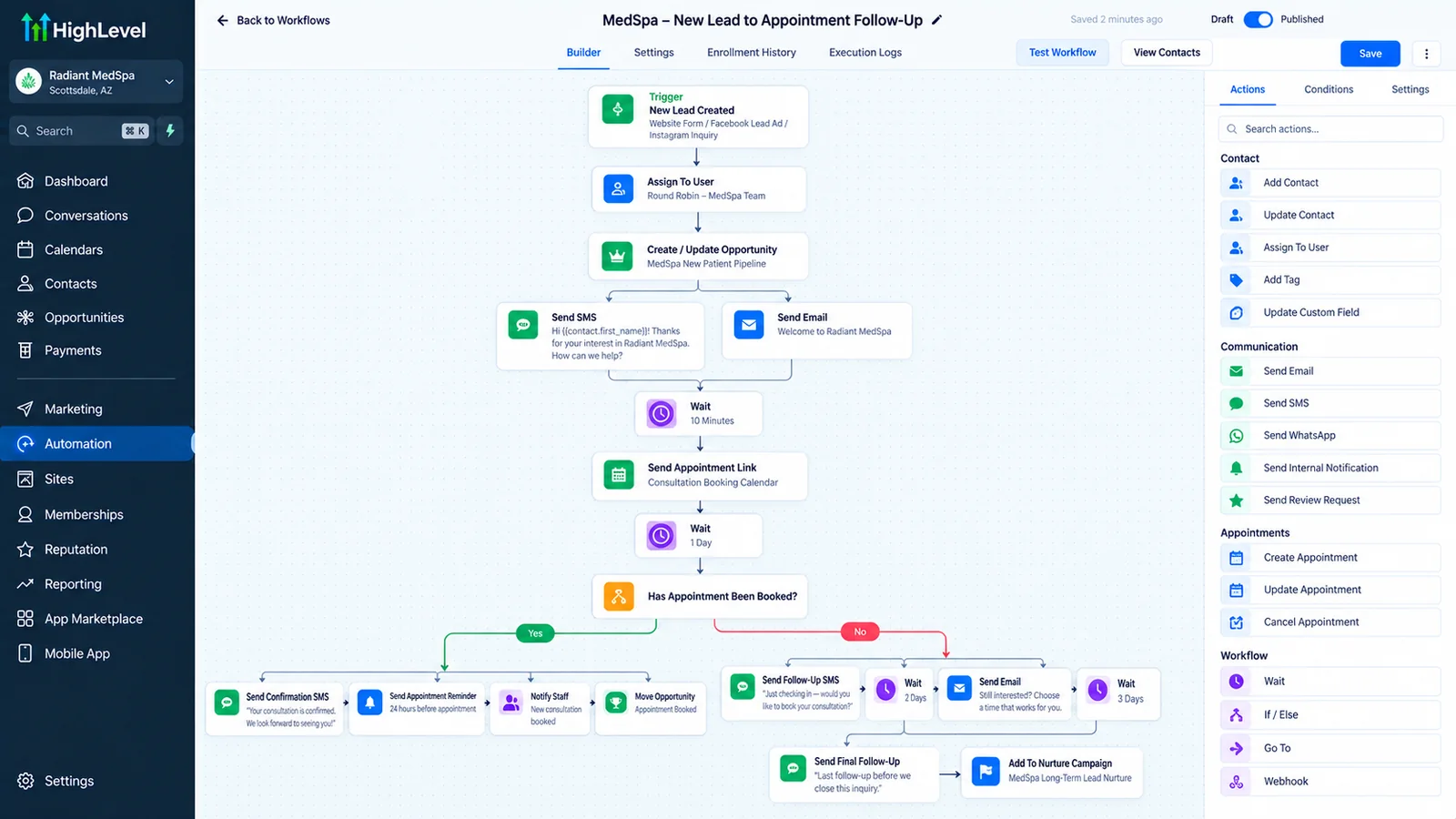
What can GoHighLevel actually do for an aesthetic clinic or med spa?
GoHighLevel runs the front-office side of an aesthetic clinic in one system: lead capture, consultation booking, appointment reminders, treatment follow-up, package tracking, review requests, and one contact record per patient. It is not an electronic health record (EHR) and does not replace charting.
Most aesthetic practices we talk to run on a patchwork: a booking widget for consults, a separate texting app for reminders, a spreadsheet for packages, and paper or a generic form tool for consent. Each piece works alone, but nothing shares data. The front desk retypes the same patient into three places, and a package renewal date lives in someone's head instead of a workflow.
GoHighLevel replaces that patchwork with one CRM record per patient and automation built around the treatment journey instead of a generic sales pipeline. Here is what stays outside it:
- Clinical charting and medical records. If you need treatment notes, treatment maps, or prescriptions, keep your EHR. GoHighLevel sits next to it and handles marketing and scheduling.
- Inventory and provider commissions. GoHighLevel can take deposits and payments, but many clinics keep their existing point-of-sale for product inventory and commission reports.
- Clinical judgment. Automation can remind a patient of an appointment. It should never decide who is a candidate for a treatment.
This guide is the broad build for any aesthetic practice. If you want us to build it for you, our GoHighLevel setup service is where that work starts.
You will see the platform called GoHighLevel, HighLevel, GHL or Go High Level. They are the same product, so everything here applies whichever name your agency or software vendor uses. If you are still comparing CRM options rather than GoHighLevel specifically, our med spa CRM and automation overview starts there.
How does GoHighLevel reduce no-shows for injectable and laser appointments?
Use a layered reminder sequence: a confirmation at booking, a reminder several days out, and a short-notice text with a one-tap reschedule link. Then make the sequence firmer for injectable and laser slots than for a free consult, because a missed slot costs more.
The most common setup we find when we audit accounts is a single reminder, sent 24 hours before. It is why no-show rates stay flat after a "we already do reminders" build. People book aesthetic appointments weeks ahead. A message the night before competes with everything else in their inbox, and by then it is too late to refill the slot.
We do not have a verified across-client no-show percentage to quote, and we would rather say so than repeat the unsourced "no-shows dropped from 20% to 8%" claims that circulate on other agency pages. What we can describe is the mechanism: more touchpoints, placed earlier, with a reschedule link that costs the patient one tap instead of a phone call.
| Appointment type | Starting reminder sequence | Why it differs |
|---|---|---|
| Free or low-cost consult | Confirmation at booking, one reminder the day before | Low cost to the clinic if the slot goes unfilled |
| Injectable (Botox, filler) or laser session | Confirmation at booking, reminder 3 to 5 days out, morning-of reminder with a reschedule link | A missed slot is high-margin revenue lost with little time to refill it |
| Package or membership session | Confirmation at booking, reminder tied to the patient's usual visit cadence, morning-of reminder | Repeat patients skip more casually once a routine feels familiar |
These timings are a starting point we would test, not a rule. Watch which reminder gets replies and cancellations for a month, then adjust. Build the sequence as a branch on appointment type, not one blanket workflow on every calendar. Our appointment booking automation work follows the same principle in other industries: match reminder intensity to what a no-show costs.
One more detail matters for text reminders. Texting patients requires consent, and rules like the TCPA apply to automated messages. This is general information, not legal advice, so have your own counsel confirm your opt-in wording. Keep reminders free of treatment details, since a text on a shared phone can reveal more than the patient wants.
How do you automate consultation booking for a med spa?
Build a provider-specific calendar with buffer time, attach a pre-consult intake form that writes medical-history and goal answers into the contact record, and let the confirmation and reminder chain run once the slot is booked.
A generic booking widget assumes every provider offers every service. In an aesthetic clinic, an injector, an esthetician, and a laser technician each have their own calendar and service menu. Build calendars around the provider and service pairing, not one shared clinic calendar. Add buffer time after longer treatments so one late appointment does not cascade through the afternoon.
On high-demand injectable consults, consider a deposit. Slots that cost nothing to cancel tend to be booked and abandoned more often, and a deposit filters casual bookings before they cost you a chair.
The intake form matters as much as the calendar. A consult booked with no history form means the provider spends the first ten minutes on questions that should already be on file, and the front desk has no record of what the patient wants treated. Route the answers into custom fields on the contact, not a PDF attachment nobody opens before the visit. If leads message after hours, AI chat for after-hours booking questions can answer and book, and AI calling to follow up on missed consults can reach the ones who never picked up.
How do you follow up on treatment packages without sounding like a sales script?
Trigger follow-up from the patient's actual treatment calendar, such as the due date for the next package session or a membership renewal window, instead of a fixed number of days after purchase. The message then reads as a scheduling reminder, not an upsell.
Package follow-up without sounding pushy
A generic drip ("it has been 30 days, come back in!") reads as exactly what it is. A patient who bought three laser sessions does not want a marketing message. They want to know when session two is due. Track the package on the contact record (sessions used, sessions remaining, next-due date) and let the message use the real numbers: "You have 2 sessions left on your package. Want to book session 2?"
- Package tracking fields. Sessions purchased, sessions used, next-due date, and an expiration date if the package has one.
- Session-due triggers. A workflow that fires as the next-due date approaches, not on a fixed day count from purchase.
- Renewal-window automation. A membership reminder timed to the real renewal date, plus a softer separate message if it lapses instead of an immediate hard sell.
- A stop rule. Once the patient books, the follow-up ends. Nothing feels more scripted than a "book now" text that arrives after you already booked.
Session counts are usually updated by the front desk after each visit, or by an integration with your point-of-sale. If your scheduling or billing tool is outside what GoHighLevel connects to natively, n8n automation can sync it.
Is GoHighLevel HIPAA compliant for a med spa?
Not by default. HighLevel says it is not HIPAA compliant out of the box: you need its paid HIPAA add-on and a signed Business Associate Agreement (BAA), and your clinic stays responsible for compliance.
According to HighLevel's own HIPAA page at the time of writing, the module is a paid add-on priced at $297 per month or $2,970 per year, on top of the platform subscription. The page says the BAA is available inside the app, that data is encrypted, and that access controls and activity logs are included. It also says your organization is responsible for meeting all HIPAA requirements. Confirm current terms directly on HighLevel's site before you rely on any of this.
If your med spa also offers a weight loss or hormone program, the intake and advertising rules are stricter. See GoHighLevel for weight loss and TRT clinics.
A BAA is the contract between a covered entity and a vendor that handles protected health information for it. HHS says such a contract must set the permitted uses of the information, require safeguards, and require the vendor to report improper use or breaches. You can read the HHS guidance on business associate contracts.
Whether HIPAA applies to your clinic at all depends on whether you are a covered entity, which turns on how you bill and how your practice is structured. A cash-only med spa may sit in a different position than a physician-owned clinic that bills insurance. That question belongs to your compliance advisor or attorney, and nothing here is legal advice.
Beyond the contract, compliance is configuration. Decide who gets access, what stays in custom fields versus your EHR, and whether medical-history answers should be collected in the CRM at all. Our practical default is to keep clinical detail in the EHR and put only scheduling and consent status in GoHighLevel. That is a design choice, not a compliance guarantee.
How do you handle before-and-after photo consent inside GoHighLevel?
Add a signed-consent custom field to the patient's contact record and put a workflow condition in front of anything that publishes a photo, so nothing goes out until that field shows consent. GoHighLevel has no native photo-consent object, so this is a pattern you build.
This is the piece almost no GoHighLevel med spa content covers, and it causes real trouble when skipped. Before-and-after photos are an aesthetic practice's most persuasive marketing asset. They are also the asset that needs documented, specific consent, not a checkbox in paragraph six of an intake form. Consent rules vary by state and by whether a photo counts as health information, so treat this as process design, not legal advice, and have your attorney approve the consent form itself.
- Add custom fields to the contact: consent status, date signed, and which uses were approved. Internal records, your website, paid ads, and social media are different consents.
- Store the signed consent document on that contact, uploaded or generated by a form.
- Put a condition step in front of any workflow that publishes or shares a photo. It checks the consent field before the action fires, not after.
- Build a revocation path. If a patient withdraws, the field updates and any scheduled post using that photo is stopped.
- Store the photo file with a reference to the contact, so a revocation can find what to take down.
The honest limit: GoHighLevel will not stop someone from pasting a photo into a social post by hand. The gate protects automated workflows and gives your team one place to check. A written rule that nobody posts without checking the field does the rest.
What does a full aesthetic-clinic GoHighLevel build actually include?
A full build maps pipeline stages to the patient journey (lead, consult booked, consult completed, treatment plan, active package, renewal), adds the reminder and follow-up workflows above, gates photos behind consent, and times review requests after a good outcome.
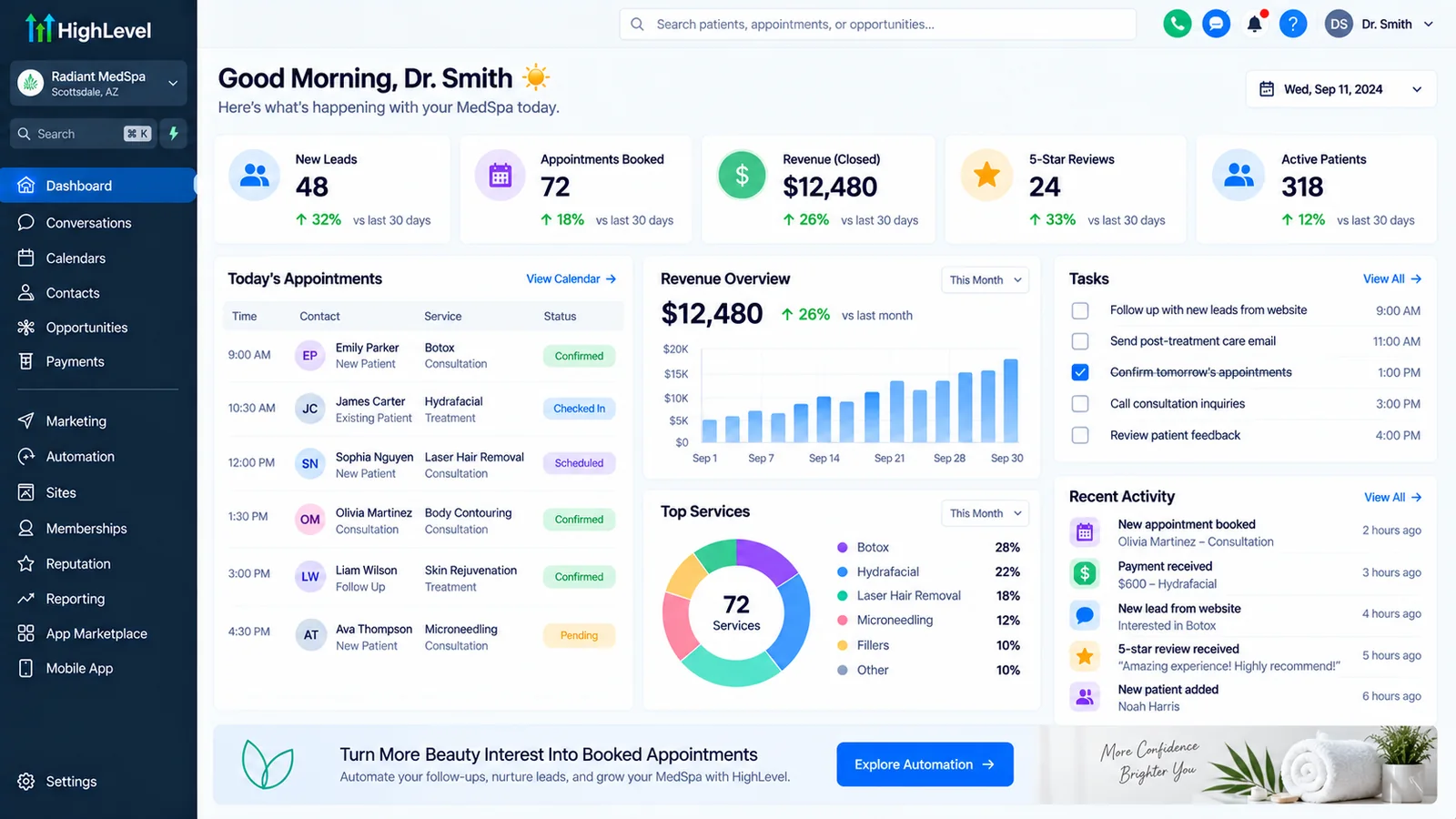
- Pipeline stages built around the patient journey, not a generic sales template.
- The reminder sequence from earlier, branched by appointment type and margin.
- Consultation booking with provider-specific calendars and an intake form feeding the contact record.
- Package and membership tracking with session-due and renewal triggers.
- Photo consent gating as custom fields plus a workflow condition.
- Review requests sent after a completed appointment once the result has settled, not at checkout when swelling or redness may still be there.
We map the real patient journey on paper first, then build the pipeline around it. It is the same order of operations as in our general GoHighLevel setup guide, applied to how an aesthetic clinic actually runs. If your clinic has several locations, the structure changes, and that work sits in the higher price range below.
How does the build change for cosmetic surgery, plastic surgery and hair transplant clinics?
The structure stays the same, but the gap between consultation and procedure is longer and the ticket is higher. Surgical and hair transplant builds add a longer nurture, photo-based first assessments, financing links, and pre-op and post-op messages tied to the procedure date.
| Part of the build | Med spa | Cosmetic or plastic surgery | Hair transplant |
|---|---|---|---|
| First step | A consult, or direct booking for repeat injectables | A surgical consultation, often virtual first | A photo assessment of the scalp before any consultation |
| Nurture after the consult | Package and rebooking reminders | A longer sequence on recovery, cost and financing, owned by a patient coordinator | The same, plus travel and procedure-day logistics for patients who come from out of town |
| Date field that drives messages | Next session due | Surgery date (pre-op instructions, post-op check-ins) | Procedure date (preparation, then check-ins over the growth months) |
| Health information collected | Medical history at intake | Surgical history and photos | Scalp photos and history |
| Pipeline stages | Lead, consult, treatment plan, active package, renewal | Lead, consult, quote sent, financing, surgery booked, recovery | Lead, photos received, assessment, consult, procedure booked, follow-up |
Two details matter more here than in a med spa. First, photos sent through a form are health information. HighLevel's help center lists form and survey submissions and email attachments among the data its HIPAA add-on covers, so turn that on before the upload form goes live (HighLevel HIPAA article, modified 11 June 2026). Second, every pre-op and post-op message is clinical content. The surgeon approves the wording, and the workflow only sends it on the right date.
Financing works best as a link to your financing provider's own application inside the nurture, with a stage in the pipeline for "financing in progress" so the coordinator knows who to call. GoHighLevel does not decide credit, and it should not hold the application data.
How much does it cost to run GoHighLevel for a med spa?
At the time of writing, the platform costs $97 to $497 a month depending on plan, plus usage fees for SMS, email, and AI. A HIPAA add-on, if you need it, is $297 a month, and a done-for-you build is a separate one-time cost.
Monthly and one-time costs
HighLevel's pricing page lists Starter at $97 a month, Unlimited at $297, and Agency Pro at $497, all at the time of writing. A single-location clinic with one or two providers rarely needs Agency Pro's reselling features. See our full GoHighLevel pricing breakdown for the plan comparison, or our GoHighLevel vs. HubSpot comparison if you are still choosing a platform.
| Cost item | Typical range at the time of writing | Notes |
|---|---|---|
| GoHighLevel subscription | $97 to $497 per month | HighLevel's pricing page; usage billed separately |
| HIPAA add-on | $297 per month | HighLevel's HIPAA page; only if you need it |
| Autoesta audit of an existing account | Free | Our typical pricing |
| Autoesta cleanup or verification of an existing account | From $200 | Our typical pricing |
| Small automation build (2 to 3 automations) | From about $1,000 | For example reminders plus intake |
| Full GoHighLevel setup | About $3,000 to $5,000 | Six months of maintenance included |
| Multi-location (5+) | $5,000 to $10,000 | Scoped to locations and providers |
| Monthly support | From $200 | Optional after the included maintenance |
The Autoesta figures are typical ranges at the time of writing, not a quote. The real number depends on provider count, package complexity, and how many systems need to connect.
What mistakes do clinics make setting this up themselves?
The common mistakes are building a generic sales pipeline instead of a treatment journey, skipping the photo-consent gate, and shipping one reminder instead of a sequence tuned to appointment value.
- Importing a generic sales pipeline. Stages like contacted, qualified, and won do not describe a consult-to-package journey, and staff abandon them within months.
- Skipping the photo-consent workflow. Consent sits on paper or in a general checkbox with no link to a specific photo or use, so nobody can show what was approved.
- One reminder for every appointment type. A missed injectable slot and a missed free consult get the same treatment even though one costs far more.
- No package-due tracking. Sessions remaining live in a spreadsheet nobody checks before a follow-up goes out.
- Treating "HIPAA compliant" as a checkbox. Assuming a plan tier covers it, instead of confirming the module, the BAA, and your own configuration.
- Never testing with a real phone. Workflows look right in the builder and then text a patient twice or at 2 a.m. Run a test contact through every path before launch.
If you already have an account with several of these problems, read about fixing a messy GoHighLevel account before you rebuild anything.
When is GoHighLevel the wrong fit for an aesthetic practice?
A single-provider practice with low appointment volume and no packages or memberships probably does not need this much automation yet. A booking widget and a spreadsheet can carry it until volume grows.
If you are one provider seeing a handful of consults a week with no package structure, the setup cost and monthly subscription likely outweigh what a full build saves. The platform earns its cost once you juggle several providers, track packages across dozens of active patients, or have already lost a high-margin slot to a reminder that never fired.
Other cases where we would point you elsewhere:
- You need an all-in-one clinical system. If charting, e-prescribing, and billing must live in one product, a purpose-built med spa EHR with its own booking may fit better than GoHighLevel beside a separate EHR.
- Your team will not update the record. Package tracking only works if session counts get entered. If that will not happen, no workflow saves it.
- Strict compliance is central to how you operate. If you must keep all patient data in a system with clinical audit features, decide that with your advisor before adding a CRM.
Agencies that send caregivers to clients' homes have a different funnel, covered in our GoHighLevel for home care agencies guide.
General and multi-specialty clinics face extra routing issues, covered in our healthcare clinics guide.
If you would rather have the build handled for you, see our done-for-you GoHighLevel med spa setup service for scope, timeline and cost.
Should a med spa build this in-house or hire it out?
Build it yourself if you are a single provider with time to test every workflow. Hire it out if you have several providers, package or membership tracking, or a launch mistake such as a missed consent gate would cost more than the setup fee.
| DIY setup | Hire it out | |
|---|---|---|
| Time | Several weeks of part-time work to build and test each workflow | Built and tested by a team that has done this pattern before |
| Risk of skipping the consent gate | Higher, since consent is easy to treat as a paper-form problem | Lower, because it is part of the standard build |
| Cost | Your time plus the platform subscription | Subscription plus a one-time setup fee scoped to your practice |
If you already have an account that is missing pieces, that is a fix, not a rebuild, and a GoHighLevel expert can audit it first. Starting fresh, our GoHighLevel setup service builds the pipeline, reminders, package tracking, and consent workflow described here. Our dental practice case study shows a similar patient-intake and reminder build, with results reported by Autoesta. The same principle carries over: one record per patient and automation matched to what a missed visit costs.
Autoesta is a 16-person team, about 8 in San Francisco and the rest in India and Nepal, and Alpit Patel is a HighLevel Certified Admin. You can contact us or book the free call below.
The reminder logic here applies to any appointment-based business. See reduce appointment no-shows.
Questions people ask about GoHighLevel for med spas
Does GoHighLevel work for cosmetic surgery and hair transplant clinics?
Yes. The consultation-led model is the same as a med spa, with a longer decision time, higher ticket and often financing, so nurture and consultation follow-up matter more. Surgical consultations collect health information, so use the HIPAA add-on and keep procedure details out of marketing texts.
Which GoHighLevel plan does a med spa need?
A single-location med spa usually fits the Starter plan at $97 a month, which includes up to three sub-accounts. The $297 Unlimited plan adds unlimited sub-accounts and basic API access, which helps with several locations or a custom booking-software sync (HighLevel pricing, checked 1 October 2026). You do not need Unlimited for HIPAA: HighLevel's help center says agencies on any plan can buy the $297 a month HIPAA add-on.
Can GoHighLevel run med spa memberships with monthly billing?
Yes. You create a recurring product, connect Stripe or another supported processor, and start the subscription from the patient's contact record, ideally with a card on file so it charges automatically (HighLevel subscriptions guide, modified 15 April 2026). Add a workflow for failed payments, and keep the session-count fields described above so the membership and the treatments stay in step.
Can GoHighLevel answer Instagram DMs for a med spa?
Yes. Once your Facebook Page and Instagram business account are connected, DMs arrive in the same conversations inbox as texts and emails. One limit: an automated Instagram DM from a workflow only delivers if the person messaged your account in the previous 24 hours (HighLevel Instagram DM action). Reply fast inside that window, then move reminders to text or email once the patient gives consent.
How do you bring back med spa patients who have not booked in months?
Build a smart list of patients whose last visit is older than their usual interval for that treatment, filtered to those who agreed to marketing messages. Send a short sequence of two or three messages with a booking link, stop it the moment they book, and end with a call task for the front desk. See follow-up that converts for the message pattern.
Can GoHighLevel send review requests only to happy patients?
It can be built that way, but it should not be. Google's Maps content policy lists selectively soliciting positive reviews as rating manipulation (Google policy), and the FTC says this practice could violate the FTC Act even though its October 2024 reviews rule does not name it (FTC Q&A). Send the review link to every patient after a completed visit. A private feedback form is fine as long as everyone still gets the review link. More in getting more Google reviews.
Is GoHighLevel a good fit for a med spa?
Yes for most multi-treatment med spas with regular consult enquiries: med spa CRM GoHighLevel setups handle consult booking, no-show reminders, package follow-up, reactivation and reviews. A single provider with few consults may not need it.
Does GoHighLevel work for weight loss clinics?
Yes. GoHighLevel for weight loss clinics uses the same consult, reminder and follow-up structure. Programs often involve health information, so decide early whether you need HighLevel's HIPAA add-on and BAA.
Is there a med spa snapshot?
Snapshots for med spas exist, but a med spa snapshot is only a starting point. It needs your services, calendars, messages and compliance settings before it is ready for patients. Our GoHighLevel expert for med spas page compares a snapshot with an expert build and lists what a snapshot leaves out.
Related: wellness clinic CRM case study, GoHighLevel pricing calculator and CRM automation by industry.