







What is a done-for-you GoHighLevel setup service for a med spa?
A done-for-you GoHighLevel setup service for a med spa is a fixed-scope project where an outside team builds and tests your patient pipeline, booking calendars, reminders, follow-up, consent handling, and reporting inside GoHighLevel, then hands over a working system. You provide the business decisions and access. The build is not the platform subscription, which you pay to GoHighLevel separately.
This page is for the owner or practice manager who has already decided a med spa CRM is worth having and now wants to know what hiring a team to build it actually involves. It covers scope, timeline, cost, what we need from you, and where the rules on consent, photos, and advertising claims change the build. If you are still deciding whether GoHighLevel suits an aesthetic practice at all, or you want the how-to detail behind each workflow, read our GoHighLevel for aesthetic clinics guide first. We keep that detail there so this page can stay on the buying questions.
Autoesta is a GoHighLevel setup agency founded in 2021, with 320+ projects delivered in 15+ countries. Our founder, Alpit Patel, is a HighLevel Certified Admin. Our published work covers a dental practice and a real estate team. We have no published med spa case study, so we do not quote client results for med spas on this page. What follows is scope, process, and prices, not promises about revenue.
You will see the platform written as GoHighLevel, HighLevel, GHL or Go High Level. They are the same product. Whether you searched for a GoHighLevel expert for your med spa, a GHL med spa setup agency or someone to install a med spa snapshot, the buying questions are the same, and they are the ones this page answers.
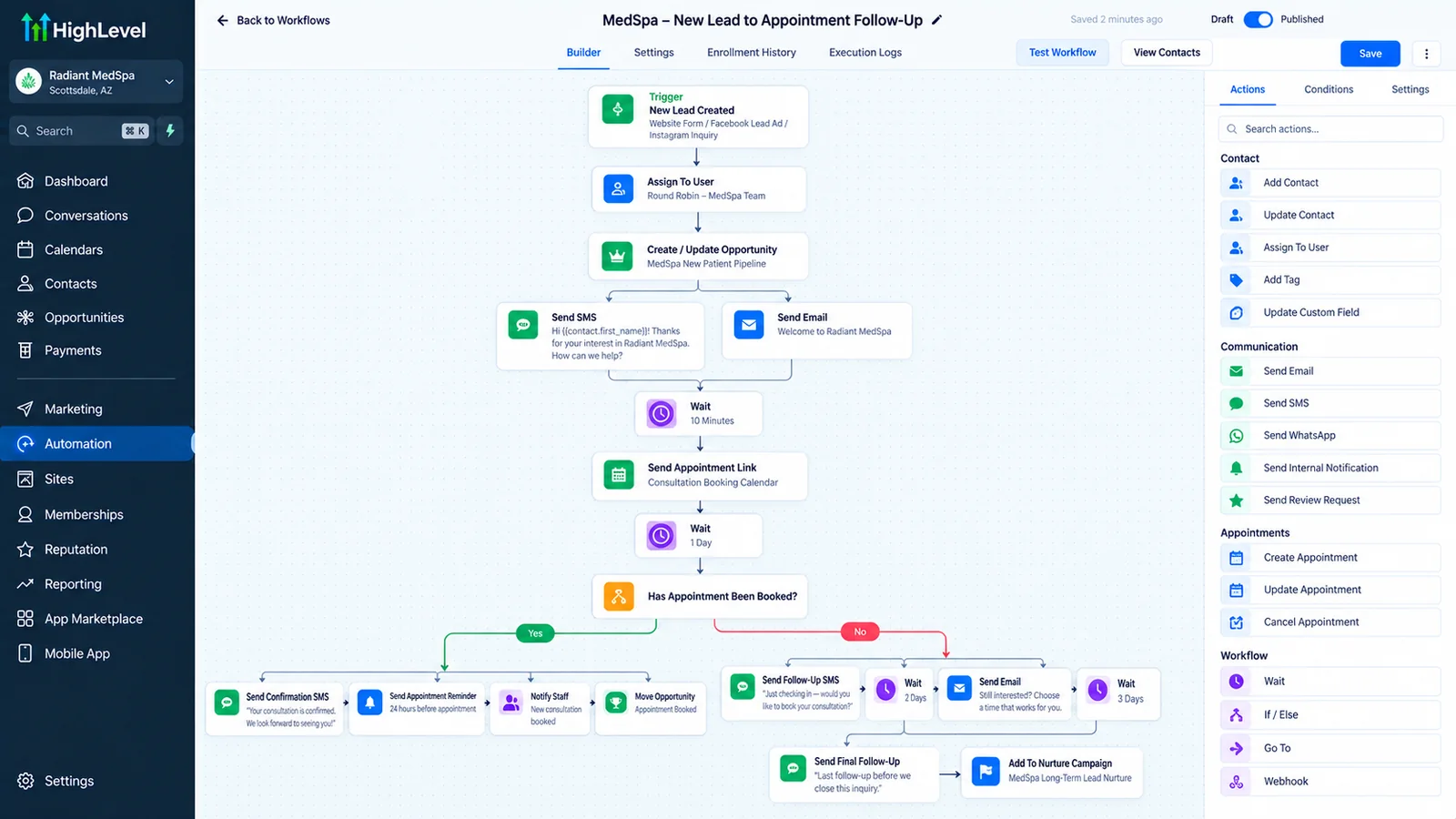
What does a med spa GoHighLevel setup include?
A complete med spa setup includes seven deliverables: a patient-journey pipeline, provider calendars with intake forms, layered reminders, package and membership tracking, a photo and text-consent gate, review requests, and reporting, plus SMS registration and staff training. Anything on this list that a proposal leaves out is a gap you would fill yourself later.
The six stages of the setup
| Deliverable | What gets built | What you decide or provide |
|---|---|---|
| Pipeline | Stages that follow the patient journey: new lead, consult booked, consult done, treatment plan sent, active package, renewal | How your team moves a lead from enquiry to first treatment |
| Calendars and intake | One calendar per provider and service type, buffer time, a pre-visit intake form that writes into the contact record | Provider hours, which services each person offers, appointment lengths |
| Reminders | Confirmation, advance reminder, and same-day reminder, branched by appointment type, each with a reschedule link | Message tone, cancellation policy wording |
| Packages and memberships | Custom fields for sessions bought, sessions used, next-due date, and renewal date, with triggers keyed to them | Your package rules and expiry terms |
| Consent gate | Text-consent capture on every form, a photo-consent field and workflow condition, opt-out handling | Consent wording approved by your own counsel |
| Reviews and reactivation | Review requests timed after completed visits, and a lapsed-patient sequence | Your review links and how you want to reach past patients |
| Reporting | A dashboard for leads, booked consults, shows, and package status | The three or four numbers you actually manage by |
| SMS registration and training | A2P 10DLC brand and campaign registration, plus a walkthrough for the front desk and providers | Legal business details and who attends training |
The reminder logic, the package fields, and the consent pattern each have a full explanation in the guide, so we will not repeat them here. The point on this page is what a project delivers and where your input is needed. One item in the table is easy to underrate: intake and consent rules differ between a free consult and an injectable visit, so the calendar setup is where most of the med spa-specific thinking happens. Our appointment booking automation page shows the same idea applied outside aesthetics.
What is not included?
GoHighLevel is a marketing and front-office system, not a clinical one. It does not replace an EHR, chart notes, or a point-of-sale system. If your practice already runs a practice-management platform, we connect the two where an integration exists, using n8n when GoHighLevel has no native connection. Ad management and content production are separate work, and so are ongoing campaigns. Our local SEO automation guide covers how GoHighLevel supports local search, but that is not part of a setup project.
Which med spa booking software does GoHighLevel connect to?
GoHighLevel connects to most med spa booking systems through Zapier, webhooks or the vendor's API rather than a built-in app. Boulevard, Zenoti and Aesthetic Record have Zapier apps, Mangomint sends webhooks, and Vagaro opens its API and webhooks on request.
We checked each vendor's own documentation on 30 September 2026 and did not find a first-party HighLevel marketplace app for any of these five, so confirm under Settings, Integrations in your account before you plan around one. The connection matters because review requests, rebooking reminders and package renewals should fire from what actually happened in your booking system, not from a guess.
| Booking platform | How it connects | Events you can use | Watch out for |
|---|---|---|---|
| Boulevard | Zapier app; API for Enterprise customers (Boulevard support) | 9 Zapier triggers, including appointment and client events | Custom API work needs Boulevard's Enterprise access |
| Zenoti | Zapier app and an API with webhooks | 40 Zapier triggers, including appointment completed, guest created and membership changes | Third-party connectors advertise a direct Zenoti to GoHighLevel link; test one before relying on it |
| Mangomint | Outbound webhooks set up by Mangomint | Appointment created, updated or deleted; sale completed; membership started or cancelled; form submitted | No Zapier app or public API found; the webhook points at a GoHighLevel inbound webhook trigger |
| Vagaro | APIs and webhooks, enabled through Vagaro's Enterprise Sales team | Appointments, customers, transactions, form responses | Access is by request, so allow time for it in the plan |
| Aesthetic Record | Zapier app | New Patient and New Invoice only | Needs a paid Zapier account; with no appointment-completed trigger, review requests usually key off a new invoice |
When the vendor gives us appointment and completion events, we sync those into GoHighLevel and keep chart notes and treatment records in the booking system. When it gives us less, as with Aesthetic Record, we design the workflows around the events that exist and tell you up front which automations that limits. If patient health information would pass through Zapier or another middleware tool, check whether that vendor will sign a Business Associate Agreement before any data flows. We cover that decision in our HIPAA automation guide.
How long does a GoHighLevel med spa setup take?
A single-location med spa typically falls in Autoesta's medium band of two to three weeks, and a small automation-only build takes five to seven days. Multi-provider or multi-location practices with integrations move toward three to four weeks, and SMS registration approval can add time that we do not control.
Typical timeline by size of build
| Size of build | Typical duration | What usually puts a med spa here |
|---|---|---|
| Small | 5 to 7 days | Two or three automations only, for example reminders plus consult booking, on an account that already exists |
| Medium | 2 to 3 weeks | A full single-location build: pipeline, provider calendars, reminders, packages, consent gate, reporting |
| Large | 3 to 4 weeks | Several providers or pipelines, a practice-management integration, or a large contact migration |
These are our own scoping bands, the same ones we publish on our GoHighLevel setup agency page. Timelines depend on complexity, integrations, and how quickly feedback comes back. The order of work looks like this:
- Strategy call and scope. We map your patient journey on paper, confirm the deliverables above, and give you a fixed scope and price.
- Access and registration. We collect logins and business details, and start the SMS registration early because carriers approve it on their own schedule.
- Structure build. Pipeline, calendars, custom fields, forms, and the consent fields go in first, because everything else refers to them.
- Automation build. Reminders, follow-up, package triggers, and review requests are built on top of that structure.
- Test with real scenarios. We run test contacts through every path: a consult that books and shows, one that no-shows, a package that reaches its due date, and a contact who replies STOP.
- Training and handover. Your front desk and providers get a walkthrough, and the six-month maintenance period starts.
The step owners tend to underestimate is the wait for feedback. A build stalls when the person who can approve reminder wording or consent language is on the treatment floor all week. Naming one decision-maker and a same-week review slot is the cheapest way to protect the timeline. When SMS registration is still pending at launch, we launch email and calendar automation first and switch texting on when the carrier approves.
How much does a GoHighLevel med spa setup cost?
At the time of writing, a full GoHighLevel setup from Autoesta typically costs about $3,000 to $5,000, which is where most single-location med spas land. A small automation build starts around $1,000, an audit of an existing account is free, cleanup starts from $200, and multi-location builds (five or more locations) run $5,000 to $10,000. The GoHighLevel subscription is paid separately.
| Option | Typical investment | Fits a med spa that |
|---|---|---|
| Audit | Free | Already has a GoHighLevel account and wants a written list of what is wrong |
| Cleanup or verification | From $200 | Has a messy account to fix, or wants a working one verified |
| Small automation build | From about $1,000 | Needs two or three automations, such as reminders and consult booking, and nothing else yet |
| Full GoHighLevel setup | About $3,000 to $5,000 | Wants the whole system: pipeline, calendars, reminders, packages, consent gate, reporting, training |
| Multi-location build | $5,000 to $10,000 | Runs five or more locations that need shared standards and reporting |
| Monthly support | From $200 per month | Wants ongoing changes after the included maintenance period |
Every build includes six months of maintenance at no extra charge. If something we built breaks during that time, we fix it. It does not cover changes made by third-party platforms outside our build, and new features you request later are scoped separately. The final price is confirmed after a free 30-minute strategy call, and the drivers of a higher price are the ones you would expect: several pipelines, integrations with a practice-management system, a large or messy contact migration, several locations, AI agents with detailed scripts, and complex compliance requirements.
What does the GoHighLevel subscription add?
At the time of writing, GoHighLevel lists Starter at $97 per month, Unlimited at $297, and Agency Pro at $497, with a 14-day free trial and usage-based charges for phone, SMS, email, and AI billed on top (GoHighLevel pricing page). Our GoHighLevel pricing breakdown explains each tier and the usage costs. Plans and prices change, so confirm them with GoHighLevel before you commit.
If your practice needs a Business Associate Agreement, HighLevel's own support article says its HIPAA package costs US$297 per month, that a signed BAA is part of it, and that it cannot be canceled, refunded, or downgraded once enabled (HighLevel HIPAA article). Read that permanence before you turn it on. Whether you need it depends on your legal status, covered in the compliance section below.
What does a first year cost in total?
The table below is arithmetic from the published prices above. It is an illustration, not a quote, and it leaves out usage charges.
| Scenario | Setup (one time) | Platform for 12 months | First-year total before usage |
|---|---|---|---|
| Single location on Starter | $3,000 to $5,000 | $1,164 ($97 x 12) | $4,164 to $6,164 |
| Single location on Unlimited | $3,000 to $5,000 | $3,564 ($297 x 12) | $6,564 to $8,564 |
| Starter plus HIPAA package | $3,000 to $5,000 | $4,728 ($97 + $297, x 12) | $7,728 to $9,728 |
Illustrative arithmetic, not client data. Whether a first-year cost like this pays back depends on your own no-show rate, package renewals, and lead volume, and we do not have a verified benchmark for a typical med spa, so we will not invent one. The practical test is to take your own average treatment value and your own current no-show count for a month, and see how few recovered appointments cover the build.
What does the med spa owner have to provide?
You provide decisions, content, and access: how a lead becomes a patient, your service menu and package rules, provider schedules, consent wording your counsel has approved, an export of your existing contacts, legal business details for SMS registration, and logins to the tools we connect. Having these ready before kickoff is the biggest factor you control in the timeline.
- Your patient journey, written down. The real steps from first enquiry to first treatment to rebooking, including the messy ones such as a consult that happens by phone.
- Service menu and rules. Which treatments need a consult first, which need a patch test or intake form, and which providers perform what.
- Package and membership terms. Session counts, expiry, transfer rules, and what happens at renewal.
- Provider calendars. Hours, appointment lengths, buffer time, and blocked days.
- Consent wording. Text-message consent language and the photo-consent form, approved by your own attorney or compliance adviser. We build the capture and the gate, and we do not write your legal terms.
- Existing contacts. An export from your current booking or CRM system, in a spreadsheet if nothing else. Say which contacts have agreed to be texted, because a list with unknown consent should not be texted.
- Business details for SMS registration. Legal name, address, tax ID, website, and how patients opt in.
- Access. Domain and DNS, your website, your booking or practice-management system, payment processor, and Google Business Profile.
- Brand and tone. How you want messages to sound, and your review links.
- One decision-maker. One named person who approves wording and answers questions within the same week.
Our general setup process uses the same preparation list. A med spa adds the consent and package items. If you cannot supply your contact consent history, we can still build the system, and we would start texting only patients who opt in through the new forms.
How is a done-for-you setup different from DIY or a template?
A done-for-you setup differs from DIY in who carries the build risk and the testing. DIY costs only your time, a purchased template gives you a starting structure that you still have to fit and test, and a done-for-you project delivers a tested system built around your services, with a fix commitment if it breaks.
| DIY | Template or snapshot | Done for you | |
|---|---|---|---|
| Cash cost | Platform subscription only | Platform plus the template price | Platform plus a one-time setup fee |
| Your time | Several weeks of part-time building and testing | Days to fit, rename, and repair it | Kickoff, answers, one review round, training |
| Fit to your services | Built to your needs, if you know the platform | Built for a generic clinic, so provider calendars and packages often need rework | Mapped to your providers, services, and packages |
| Consent and opt-out | Easy to skip until something goes wrong | Depends on what the template author included | Part of the scope, with your counsel's wording |
| Testing | Usually one or two test contacts | Rarely tested against your setup | Every path tested before handover |
| If it breaks later | You debug it | You debug it | Six months of maintenance included |
The pattern behind that table is the one we see in accounts we audit. A self-built workflow works with one or two clean test contacts, then misbehaves when real patients arrive with duplicate records, missing phone numbers, or replies out of sequence. The failure is quiet, and the cost shows up as missed rebookings, not an error message. If you choose DIY, have the account reviewed by a GoHighLevel expert audit (free) before real patients flow through it. If you have already built something and it has gone sideways, our cleanup checklist shows the order to fix it. For how to build each workflow yourself, use the GoHighLevel setup guide.
Should you buy a med spa GoHighLevel snapshot or hire an expert?
Buy a med spa snapshot if you have the time to adapt and test it yourself. Hire a GoHighLevel expert if you want it working with your providers, packages, booking software and texting registration. A snapshot is a template, and it leaves out the parts that usually break.
HighLevel's snapshots overview (modified 30 September 2026) says a snapshot copies configuration: workflows, calendars, pipelines, custom fields, forms, templates and dashboards. It says contacts and appointments, conversations, Stripe connections and other third-party integrations, and assigned phone numbers do not transfer. Texting registration is filed for your own business, so it happens in your account whatever template you start from.
| What a med spa needs | Comes with a snapshot? | Who does it |
|---|---|---|
| Pipeline, calendars, forms, workflow templates | Yes, as a starting structure | Still renamed and fitted to your providers and services |
| Booking software connection | No | Set up per vendor, as in the booking software table above |
| Phone numbers and payment connection | No | Connected in your account |
| A2P texting registration | No | Filed for your business, with form wording that matches |
| Your contacts and consent history | No | Imported and tagged, with consent status kept |
| Testing against your real cases | No | Done before patients flow through it |
A good snapshot can save build hours. What you pay an expert for is the fitting and the testing. If you have already bought a snapshot, it is not wasted: we can start from it, and the free audit tells you how much of it is usable. Our answer on whether snapshots are worth buying covers the trade-off in more detail.
What consent, photo, and advertising rules affect a med spa setup?
Three sets of rules shape the build: consent to send marketing texts, written authorization to use identifiable patient photos in marketing when HIPAA applies, and advertising rules for treatment claims and testimonials. The summaries below come from official sources and are not legal advice, so confirm your obligations with your own attorney.
| Topic | What the official source says | What we configure |
|---|---|---|
| Marketing texts | The FCC defines prior express written consent as a signed written agreement (an electronic signature can count) that clearly authorizes the seller to send marketing messages, and that says signing is not a condition of buying (47 CFR 64.1200) | Consent checkbox and disclosure on every form, stored on the contact record |
| Opt-out | The same rule treats replies such as "stop" or "unsubscribe" as a valid revocation of consent | STOP handling that removes the contact from texting workflows |
| Carrier registration | HighLevel says A2P 10DLC registration is required to send business texts to US recipients from standard 10-digit numbers, and it asks for separate, unchecked consent checkboxes for marketing and non-marketing messages (HighLevel A2P article) | Brand and campaign registration, plus compliant form wording |
| Patient photos | HIPAA lists full-face photographic images and comparable images among identifiers (45 CFR 164.514), and a covered entity needs a signed authorization to use protected health information for marketing (45 CFR 164.508) | A photo-consent field and a workflow condition that blocks use until it is complete |
| Testimonials and results | The FTC says an ad featuring an exceptional result must make clear what people can generally expect, and that a material connection such as free products must be disclosed (FTC endorsement guidance) | A consent field that records which uses a patient approved, so the team can check before posting |
Do the texting rules apply to appointment reminders?
Marketing and appointment messages are treated differently, which is why HighLevel asks for two separate consent checkboxes. We build them as separate message categories, so a promotion never goes out under consent that was given for reminders only. The FCC's rule text also sets a calling window of 8 a.m. to 9 p.m. at the recipient's location for telephone solicitations. We schedule marketing sends inside it, and your counsel should tell you whether your state is stricter. The FCC's older "one-to-one" consent rule was vacated by the Eleventh Circuit in January 2025, so the plain signed-consent standard above is the one we build to.
Adding GLP-1 or weight loss services brings prescription-drug advertising limits and more patient data. We cover both in GoHighLevel for weight loss clinics.
Is my med spa covered by HIPAA?
Maybe. CMS explains that a health care provider is a covered entity when it electronically transmits standard health transactions, such as insurance claims (CMS covered entities page). A practice that bills insurance electronically is likely covered. A practice that only takes cash may not be, though state privacy laws can still apply. Ask your attorney, and use CMS's decision tool as a starting point. The answer decides whether you need a BAA with HighLevel and whether the photo-authorization rules above bind you. Whatever the answer, we recommend a written photo consent that records exactly which uses a patient approved.
Can we say "results may vary" and post any photo?
No. The FTC's health-claims guidance says marketers need competent and reliable scientific evidence for health-related claims, and that testimonials and anecdotes alone do not substantiate them (FTC health products compliance guidance). That guidance is written about health products and applies to what you claim in ads and on landing pages. We do not write treatment claims for you. Have your medical director or counsel approve any claim before it goes into a template we build, and remember that state rules on advertising medical services vary.
What happens after the med spa system goes live?
For the first six months after delivery, anything we built that breaks is fixed at no extra charge. After that, monthly support from $200 covers ongoing changes, or you run the system yourself using the documentation and training from handover.
The maintenance period does not cover platform changes outside our build or new features you request later, which are scoped separately. In the first weeks, the useful checks are the plain ones: whether reminders fire for each appointment type, whether a STOP reply removes a contact from texting, whether a package due-date message goes to the right patient, and whether the consent field is filled in on new contacts. A quarterly review of tags, workflows, and integrations keeps the account from drifting, and our cleanup checklist doubles as the review list. Some practices later add an AI chat agent for after-hours questions or an AI calling agent for missed calls. Those are separate scopes with their own consent considerations.
How do you choose a GoHighLevel expert or setup agency for a med spa?
Choose a GoHighLevel setup agency that gives a written scope, tests every path before handover, handles SMS registration and consent capture as part of the work, and can explain what happens when something breaks. Ask each agency or provider the same questions and compare the answers, not the headline price.
- What is in the written scope, deliverable by deliverable? A vague "full setup" hides gaps such as packages, consent, or reporting.
- Who registers the SMS campaign, and what happens if it is rejected?
- Whose account is it? Ask who holds the agency and sub-account logins, and whether you can export your data and workflows at any time.
- How is it tested? The answer should name scenarios, such as a no-show or a STOP reply, not "we check it works."
- What is covered after launch, and for how long?
- Who does the work, and what credentials do they hold? Our own answer is on the page about what makes a real GoHighLevel expert.
- Do they say when you should not buy? A provider that never talks a client out of a project is selling, not advising.
If you want a US-based team, see our page on how to hire a GoHighLevel expert in the USA. We are headquartered in San Francisco with a 16-person team, about eight in San Francisco and the rest in India and Nepal, working with clients in more than 15 countries.
What if your med spa already has a GoHighLevel account that is not working?
Then you need a GoHighLevel expert to audit and repair it, not a new build. Autoesta audits an existing account for free and quotes cleanup or verification from $200 at the time of writing. A rebuild is only priced like a new setup if the audit shows the account cannot be repaired.
The problems we find most often in med spa accounts are consultation reminders that send twice or not at all, Meta lead ads that never reach a pipeline, A2P registration rejected so texts silently fail, photo consent collected on paper instead of on the contact record, and snapshot workflows switched on that nobody configured. Each has a specific fix. See how the audit works on our GoHighLevel expert page, and why a workflow sends a message twice for the most common one.
When is a done-for-you setup the wrong choice?
A done-for-you setup is the wrong choice for a solo provider with a few consults a week and no packages, for a practice whose real need is clinical charting, and for an owner who has not settled how the practice sells. In each case, a cheaper or different step should come first.
- You are one provider with light volume. A booking widget and a spreadsheet may cover you until volume or package complexity grows. A $3,000 to $5,000 build plus a monthly subscription will not pay back at a handful of consults a week.
- You need an EHR. GoHighLevel does not chart or store clinical records as an EHR does. It sits beside one.
- Your process is undecided. If you are still choosing between package models or considering a new location, wait. Building automation around a process that changes next quarter means paying for it twice.
- You want the build as a compliance shield. No CRM makes a practice compliant. Consent capture helps you keep records, and the legal obligations stay with you and your counsel.
- You already have an account that mostly works. Start with a free audit or the cleanup checklist. Rebuilding what already works wastes money.
- You want guaranteed revenue. We will not promise one. A CRM removes leaks, and it does not create demand.
We would rather say this on a free call than after an invoice. If your situation fits one of these, we will say so and point you to the smaller step.
More questions about GoHighLevel med spa setup
Do I need a GoHighLevel expert for my med spa, or can I set it up myself?
You can set it up yourself if you have time to learn workflows, A2P registration and HIPAA settings, and one person to own it afterwards. Most med spa owners hire a GoHighLevel expert because the mistakes, such as reminders that do not send, cost booked consultations before anyone notices.
What does a GoHighLevel consultant for a med spa cost?
At Autoesta, at the time of writing, an audit is free, cleanup of an existing account starts from $200, a small build is about $1,000 and a full med spa setup is $3,000 to $5,000. Hourly GoHighLevel consultants also exist; ask for a fixed scope so you know the total before work starts.
Can you set up a med spa that already has a GoHighLevel account?
Yes. We start with a free audit so the scope reflects what is there. Some pieces get fixed, some get rebuilt, and your contact data and message history are kept. That is often cheaper than a full new build.
Do I have to replace my booking or practice-management software?
Not necessarily. GoHighLevel has its own calendars, but many practices keep a practice-management system for charting and payments. We can connect it through n8n or another integration, or move booking into GoHighLevel if that suits you better. The right choice depends on what the other system exposes, and the booking software table above shows what Boulevard, Zenoti, Mangomint, Vagaro and Aesthetic Record each offer.
Can you build it for more than one location?
Yes. Builds with more than five locations run $5,000 to $10,000 at the time of writing, with shared standards and combined reporting. Smaller multi-location practices are scoped on the strategy call.
Will you write our consent forms and treatment claims?
No. We build the capture, storage, and workflow rules, and you supply wording that your own counsel or medical director approves. That split keeps legal responsibility where it belongs.
Do you run our ads and social media?
No. A setup project builds the CRM and automation that handle leads once they arrive. Ads, content, and local search are separate work.
How do we get started?
Book the free 30-minute strategy call from any button on this page, or use the contact page. Bring your current booking process and your service menu. You leave the call with a scope, a price range, and an honest view of whether a build or an audit fits first. You can also browse our case studies to see how we document finished builds.
Is GoHighLevel HIPAA compliant for a med spa?
Not by default. HighLevel sells a HIPAA add-on at $297 a month that adds a signed Business Associate Agreement, encryption of stored health data, audit logs and enforced multi-factor authentication, and it cannot be cancelled or refunded once bought (HighLevel HIPAA article, updated 11 June 2026). Whether you need it depends on whether your practice is a covered entity, which the HIPAA answer above explains.
Can GoHighLevel take a deposit when a patient books?
Yes. HighLevel calendars can collect a payment at booking, either a fixed deposit or a percentage of the service price, through a connected payment gateway such as Stripe (HighLevel calendar payments). Settle your cancellation policy first, so the deposit amount, the refund rule and the reminder wording all say the same thing.
Can an AI receptionist answer our med spa calls in GoHighLevel?
Yes. GoHighLevel includes Voice AI agents that can answer calls, handle common questions and book into your calendars, and we can configure one inside a med spa build or as a separate project. We set it to pass anything clinical to your staff and to stick to hours, approved prices and booking. Our AI receptionist page covers scope and cost.
How much does texting registration cost for a med spa?
HighLevel lists a one-time fee of $22.50 for a low-volume or sole-proprietor brand, or $64 for a high-volume brand, each including the first campaign and Fast Track review, plus a campaign fee of $1.50 to $10 a month (HighLevel A2P fees, updated 24 September 2026). Each message is billed on top. Our A2P registration guide covers approval and rejections.
Can you build separate pipelines for Botox, fillers, laser and body treatments?
Yes, but most med spas are better served by one patient pipeline with a service field, because the stages are the same for every treatment. A separate pipeline earns its place when a service sells differently, such as body contouring packages with a long gap between consult and purchase. Reminders and aftercare still branch by service, so a laser patient never gets injectable instructions.
Do you set up GoHighLevel for med spas outside San Francisco?
Yes. We build remotely for med spas across the US and in other countries, with the team split between San Francisco, India and Nepal. Calls run on video, so your location mainly changes which state rules your counsel checks, not how the build works.
What stays in our existing med spa software?
Your EMR or booking system stays the record for treatments and charts. The GHL med spa setup handles enquiries, reminders, reactivation and reviews around it, and a med spa GoHighLevel snapshot speeds up the first build.
Related: wellness clinic CRM case study, GoHighLevel pricing calculator and CRM automation by industry.