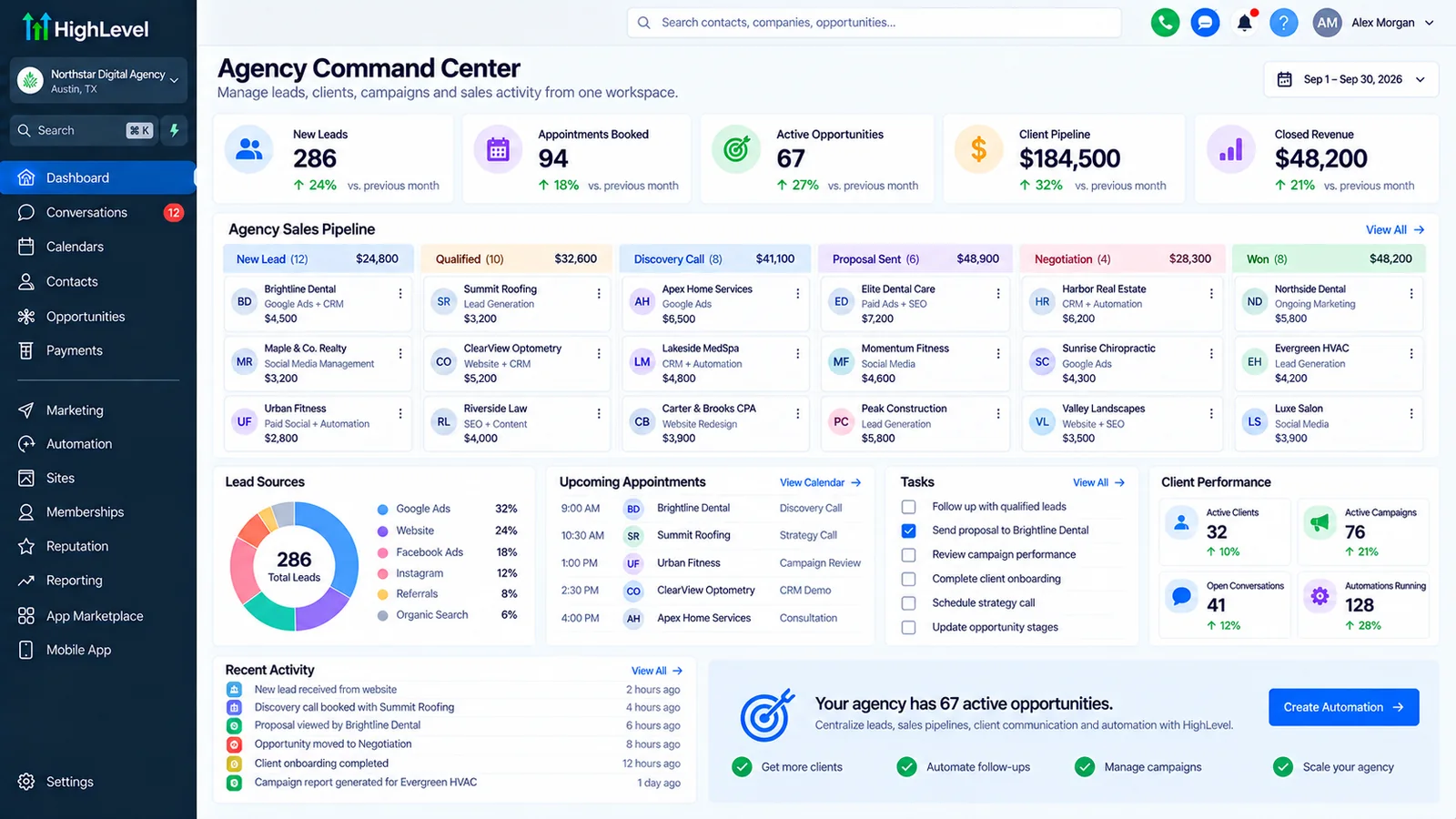
What does it mean to build a SaaS business on GoHighLevel white label?
Building a SaaS business on GoHighLevel white label means reselling the platform under your own brand and your own pricing. Your clients see your logo, your domain, and your invoice, while GoHighLevel runs the software behind it.
The client never sees GoHighLevel. They see your login screen and an invoice from your company, and what they use is a sub-account on infrastructure GoHighLevel operates. From their side, you are the vendor. That is the appeal: you sell software without building it, and you keep the recurring revenue instead of sending a client to someone else's checkout page.
This is a different business from running an agency on GoHighLevel. An agency uses the platform to deliver client work. A white-label SaaS business sells access to a rebranded version of the platform itself, billed as a subscription. Some companies do both, an agency that also offers its own branded software to clients who want to run things themselves. We come back to that mix further down.
What are GoHighLevel's white label and SaaS mode, exactly?
White label replaces GoHighLevel's branding (logo, custom domain, login screen) with yours. SaaS mode is the separate feature set that automates selling the rebranded platform: a plan builder, Stripe billing, and sub-account creation at checkout.
Online, these two get described as one feature. They are not. You can white-label the look of the platform without ever selling it as a product, which is useful if you only want your own team and clients to log into something that carries your name. SaaS mode is the layer on top. It turns the rebrand into a storefront: prospects choose a plan, Stripe charges their card, and a sub-account is created without anyone on your team clicking a button. HighLevel's support documentation describes the same flow. At checkout the sub-account is created or linked to the customer, and if a snapshot is attached to the SaaS plan, that snapshot is applied, so the new account arrives pre-built (HighLevel: Getting Started with the SaaS Configurator).
| White label alone | White label plus SaaS mode | |
|---|---|---|
| Branding | Your logo, domain, and login screen | Same, plus a client-facing pricing and signup flow |
| Billing | You invoice clients however you already do | Stripe billing tied to the plan each client picked |
| Sub-account creation | You or your team create each one | Created or linked at checkout when a plan is bought |
| Snapshot on signup | You load it by hand | Attached to the plan and applied at signup |
Which GoHighLevel plan do you need for white label and SaaS mode?
At the time of writing, white label is available from the $297 per month Unlimited plan, and SaaS mode requires the $497 per month Agency Pro plan. The $97 Starter plan includes neither.
Which plan includes what
These figures come from GoHighLevel's own pricing page as we read it in September 2026. Plan gating has changed before, so confirm it on HighLevel's pricing page before you commit. We track the tiers and the usage add-ons in more detail on our GoHighLevel pricing breakdown.
| Plan (at the time of writing) | Monthly price | White label | SaaS mode |
|---|---|---|---|
| Starter | $97 | No | No |
| Unlimited | $297 | Yes | No |
| Agency Pro | $497 | Yes | Yes |
Source for the table: gohighlevel.com/pricing, read September 24, 2026. HighLevel also lists an Enterprise tier with custom pricing. If you are still deciding whether GoHighLevel is the right platform to build on at all, our GoHighLevel vs HubSpot pricing comparison covers the platform economics.
What does white-labeling GoHighLevel actually cost?
Beyond the GoHighLevel subscription, a proper white-label build costs $5,000-$7,000 through Autoesta at the time of writing. That covers branding, pricing and Stripe setup, a tested snapshot, and a full dry run, on top of whichever plan tier you need.
That figure is our own pricing for the build, not a market average. It covers the parts that are easy to underestimate:
- Applying the branding consistently across the web app, the login screen, and email notifications.
- Building the plans and the Stripe connection, then running a real charge through them.
- Building a snapshot that deploys cleanly into a brand-new sub-account, rather than one that only works because someone has been patching it by hand.
- A full signup-to-onboarding dry run before a real client ever sees your pricing page.
| Cost type | What it covers | Who sets the number |
|---|---|---|
| One-time build | Branding, plan setup, Stripe connection, snapshot build and testing | Autoesta: $5,000-$7,000 at the time of writing |
| Recurring: platform | Your GoHighLevel subscription tier | GoHighLevel, per the table above |
| Recurring: usage | SMS, calling, email, and AI usage your clients generate | GoHighLevel and its telecom vendors, billed to you |
| Recurring: your time | Support, billing exceptions, snapshot maintenance | You, or a support retainer (ours starts from $200 a month) |
The usage row is the one first-time resellers miss. It is billed to you based on what your clients actually send and call, so it scales with your client base whether or not you have planned to rebill it. HighLevel's pricing page lists rebilling of telecom and AI usage with your own markup on the Unlimited, Agency Pro, and Enterprise plans, so the mechanism exists. The risk is choosing the markup after launch instead of before. If you set it too low, one client who sends an unusual volume of texts in a month can cost you more than they pay you.
How do you price plans for your sub-account clients?
Price around what a client cannot easily get elsewhere, not around what GoHighLevel charges you. Offer at least two tiers, so a light user does not subsidize a client who sends thousands of texts a month.
A common structure is a base tier with CRM, calendars, and basic automation for clients who mostly need the core platform. A higher tier adds SMS and calling volume, AI agents, and priority support for clients who work the system harder. The SaaS Configurator is where you build those plans and connect them to Stripe (HighLevel support).
- Do not price flat against a heavy user. A single flat price works until one client's usage erases the margin on every other client on that tier.
- Decide your rebilling markup before launch. Apply it the same way to every client so nobody meets a surprise line item.
- Leave room above your top tier. A client who outgrows your highest plan should be a sales conversation, not a wall. Know what you will say before it happens.
- Price the support you will actually give. If a tier includes onboarding help, count the hours it takes, not the hours you hope it takes.
What you charge each tier depends on your market and the clients you already have. We do not publish a suggested price, because we have not audited your client base and any number we gave would be a guess. Launch with a reasoned first version, watch real usage for a few months, and adjust.
What do you have to build before you can sell this?
Before your first paying client you need a working rebrand, a snapshot that deploys cleanly into a new sub-account, Stripe billing tested end to end, and at least one full signup-to-onboarding dry run using a test account.
Launch checklist, in order
- Brand assets and domain. Logo, colors, and a domain you control, applied to the web app, login screen, and outbound email.
- SaaS Configurator plan setup. Build your tiers and the limits attached to each one.
- Stripe connection and a real test transaction. Connect billing and run an actual charge through it before trusting it with a client.
- A snapshot built and tested in a throwaway sub-account. Deploy it fresh, the way a client's account will arrive, not into an account you have been hand-fixing for months.
- One full dry run. Sign up as a client, pay, and confirm the sub-account is created and looks right from the outside.
- A documented support process. Decide who answers a ticket, and how fast, before the first one arrives.
The same discipline applies here as in any GoHighLevel build: map the process, then test it with a real dry run before turning it on. We lay out that build order in our GoHighLevel setup guide. The sequence matters just as much when you resell, because a snapshot that mostly works is what generates support tickets once real clients are on it. If the account you would build from is already cluttered, fix that first. Our guide to fixing a messy GoHighLevel account covers the order, and copying a messy account into a snapshot copies the mess into every client.
How is a white-label SaaS business different from running an agency?
An agency sells your team's time and results. A white-label SaaS business sells access to software you maintain, so revenue is recurring, but the risk shifts from "did we deliver the project" to "does it keep working for every client, every month."
| Agency | White-label SaaS | |
|---|---|---|
| What you sell | Your team's time and delivered results | Ongoing access to a branded product |
| Revenue shape | Project fees, sometimes retainers | Monthly subscriptions across many sub-accounts |
| Billing ownership | You invoice on your own terms | You own Stripe, failed payments, and plan changes |
| Where support comes from | Clients you onboarded and trained yourself | End clients who may never have spoken to you before signing up |
| What breaks at scale | Your team's hours run out | A snapshot update, a billing edge case, or one heavy plan tier |
Neither model is easier. An agency has a ceiling tied to hours. A white-label SaaS business has a ceiling tied to how much billing and support complexity you can absorb before your margin disappears. Many agencies run both, offering the branded product as a self-serve add-on next to done-for-you work such as the GoHighLevel automation for agencies we build. When a reseller's clients need integrations they cannot build themselves, that work usually lands on n8n automation or Zapier, and it is worth deciding up front whether you will offer it as paid help.
What ongoing work does this take once clients are signed up?
Ongoing work includes billing exceptions, support tickets from clients who assume you built the whole platform, snapshot updates that do not break accounts already live, per-client SMS compliance, and usage monitoring so a heavy client does not erase your margin.
- Billing exceptions. Failed cards, disputed charges, and clients who need a plan change in the middle of a cycle.
- Support tickets. Clients contact you, not GoHighLevel, when anything looks broken, including features you did not build.
- Snapshot updates. Pushing a new version of your snapshot to accounts that are already live is a release, not a copy. Clients may have customized their accounts, so decide how you will version and announce changes before you have twenty of them.
- Usage monitoring. Watching for a client whose SMS or calling volume has grown past what their plan and your markup can absorb.
- SMS compliance. HighLevel's A2P 10DLC registration is started from inside each sub-account's Trust Center and asks for the client's legal business details, which must match official records (HighLevel: Registering your A2P brand). Plan on handling it per client rather than once for the whole agency, and confirm the current rule with HighLevel support. This is general information, not legal advice; check current carrier and HighLevel rules for your clients' use cases.
None of this is unusual for running software. It is the same category of work any SaaS company does. The gap we see in most white-label tutorials is that they treat this list as an afterthought, when it is the actual job.
Is white-label GoHighLevel SaaS passive income?
No. It is a real software business with billing, support, and churn to manage every month. The recurring revenue is real, but so is the recurring work, and none of it runs itself after launch.
This matters because it is often sold the other way. A rebranded login screen and an automated Stripe charge can look like a set-and-forget system on a sales page. A client who cannot log in on a Monday morning will not wait for you to check in on your own schedule. Every sub-account is a customer relationship with the expectations any software customer has: it should work, and if it does not, someone should answer quickly. Some pages that rank for this topic quote large monthly revenue figures. We do not repeat them, because none of them name a business, a timeframe, or how the number was calculated. The business model can be a good one. "Build once, collect forever" is not an honest description of running it.
What mistakes make a white-label SaaS launch stall?
The most common stall points are launching before the snapshot has been tested end to end, pricing flat with no usage tiering, and leaving support undefined until clients start filing tickets.
- Skipping the full dry run. A snapshot that looks right in the builder can still fail when a real signup hits it. The first person to find that out should not be a paying client.
- Flat pricing with no usage plan. Covered above, and the fastest way to turn one heavy client into a loss.
- No documented support process. The first ticket arrives sooner than most people expect. Deciding who handles it afterward costs trust you do not get back.
- Testing only what is visible. A logo change is obvious right away. A broken calendar sync or a missing email template is not, until a client hits it.
- No plan for updating the snapshot. Improvements you make after launch do not reach live clients on their own, and pushing them carelessly can disturb what already works for them.
- Building on a cluttered account. Duplicate contacts, dead workflows, and tag sprawl in your source account travel into every new sub-account.
When is white-labeling GoHighLevel the wrong move?
It is the wrong move if you have no channel to sell to, meaning no client base, audience, or niche, or if you do not want to run ongoing software support. The platform gives you a product, not customers or a support team.
If you are starting from zero, a white-label product does not solve the harder problem of finding buyers. It only gives you something to sell once you have them. It is also the wrong move if what you want is fewer support obligations, since reselling software adds a support surface that most service businesses do not carry today. Three other cases to weigh honestly:
- You only need the platform for your own business. A standard GoHighLevel setup costs less and skips the billing and support layer.
- Your clients need heavy custom work. If every client needs bespoke automation, you are running an agency with a software logo. Price it as an agency, or hire a GoHighLevel expert to handle the custom layer.
- Cash is tight. Between the $5,000-$7,000 build, the Agency Pro subscription, and months before enough clients sign up, this is a slow-payback project. Do not fund it with money you need for rent.
If your goal is to automate your own agency's operations rather than sell software to other businesses, our agency automation service is the more direct fit.
How long does it take to get a white-label SaaS business generating revenue?
It depends on how fast you can build the offer and how many people you already have to sell it to. A business with an existing client base or audience can reach its first paying signups much sooner than one starting from a cold list.
We will not quote a fixed timeline, because any page that does, without knowing your starting point, is guessing. The build steps are the same whatever your audience size: branding, plan setup, billing, snapshot testing, and a dry run. What varies is everything after them, meaning how fast you get the first signup and how fast word spreads from there. If you already run an agency, your existing clients are the obvious first buyers, and you can test the offer with a handful of them before you market it publicly. For a sense of how we report client outcomes, see our case studies, including the real estate CRM automation case study. That study is an agency-style build, not a white-label SaaS result, and we do not claim white-label revenue outcomes.
Should you build this yourself or hire it out?
Build it yourself if you are comfortable with Stripe and the SaaS Configurator and can test thoroughly before your first client. Hire it out if the cost of a broken billing flow or an untested snapshot is higher than a one-time setup fee.
The build is not exotic. HighLevel documents the tools, and every piece sits inside the platform you already pay for. What takes experience is knowing where it breaks: which settings need testing twice, what a real signup exposes that a builder preview does not, and how to set up rebilling so it survives a client who behaves differently than you planned. Our white-label builds exist to close that gap, at the $5,000-$7,000 figure covered above. If you also want AI agents or custom workflows inside the product, see our AI automation services; that work is scoped separately.
Before you decide, it helps to know who you are hiring. Our note on what makes a real GoHighLevel expert explains how to judge one, and you can contact us or book a free 30-minute strategy call. We will tell you whether a white-label build fits what you are trying to do, and if it does not, we will say so.
Building your own software product instead of reselling a platform? See SaaS product development.
Questions people ask about GoHighLevel white label
What is GoHighLevel SaaS mode?
GoHighLevel SaaS mode lets an agency sell sub-accounts as its own software subscription, with Stripe billing and plans it defines. At the time of writing it needs the $497 a month Agency Pro plan; Go High Level white label on its own starts on the $297 Unlimited plan.
Can I rebill SMS and AI usage to clients?
Yes, on SaaS mode HighLevel lets you rebill usage such as SMS, calls, email and AI to sub-accounts, with a markup you set. Check the current rebilling rules in HighLevel's documentation before you set prices, because usage costs change.
Is there a white-label desktop or mobile app?
HighLevel offers a branded mobile app option for agencies as a paid add-on, so clients see your brand instead of HighLevel's. Snapshots then set up each client account with your standard pipelines and workflows.
Related: custom software development company, dental CRM case study, GoHighLevel pricing calculator, GoHighLevel September 2026 updates, GoHighLevel AI Studio going live and whether pre-built snapshots are worth buying.