What can GoHighLevel do for a dental practice?
GoHighLevel can run the communication side of a dental practice: capture new-patient enquiries, book appointments, send reminders, bring lapsed patients back, and ask for reviews. It does not hold clinical charts, billing, or insurance, so it works next to your practice-management software, not instead of it.
HighLevel's own dental operations playbook lists the same jobs: intake forms that trigger workflows, online booking on the website and Google Business Profile, multi-step reminders, missed-call text-back, recall and hygiene check-up messages, and post-visit review requests. That is a marketing and front-desk toolkit. The playbook says nothing about practice-management integration or HIPAA, which is why those two topics get their own sections below.
You will see the platform called GoHighLevel, HighLevel, GHL or Go High Level. They are the same product, so a GHL dental setup, a Go High Level dentist build and GoHighLevel for dentists all describe the work on this page.
Here is how the five jobs split between the two systems in a typical practice:
| Job | What GoHighLevel does | What your practice-management system (PMS) still owns |
|---|---|---|
| New-patient lead capture | Collects web forms, chat, missed calls, and ad leads into one pipeline and replies in minutes | The patient chart, created once a person is actually scheduled |
| Appointment booking | Offers a booking calendar or request form and sends confirmations | The real schedule: operatories, provider time, procedure length |
| Reminders | Sends SMS and email sequences and handles replies | The appointment record and confirmation status |
| Recall and reactivation | Runs the outreach sequence and tracks who responds | Who is actually due, based on treatment history and last visit |
| Reviews | Sends review requests after a visit and routes replies | Nothing, apart from the visit-completed signal |
The right column matters more than the left. The most common failure in dental automation is GoHighLevel acting on a copy of the schedule that is out of date. The rest of this page is mostly about keeping the two systems honest with each other.
Does GoHighLevel replace Dentrix, Eaglesoft, or Open Dental?
No. Dentrix, Eaglesoft, and Open Dental are practice-management systems that hold charting, clinical records, treatment plans, insurance claims, and billing. GoHighLevel is a CRM and messaging platform, and it is not built to do any of those things.
Who does what: GoHighLevel vs your practice software
The confusion comes from the word "CRM." A patient record in GoHighLevel holds a name, phone, email, tags, conversation history, and pipeline stage. It does not hold a periodontal chart, an X-ray, a claim, or a ledger. If a vendor tells you GoHighLevel can replace your PMS, they are describing something else, and you should ask what happens to your clinical records.
What GoHighLevel does replace is the pile of small tools that grow around the PMS. Think of a form plugin, a text-reminder service, a review-request tool, a landing-page builder, and the front desk's call-back spreadsheet. Consolidating those is a fair reason to adopt it. Replacing the system of record is not. Our GoHighLevel pricing breakdown covers what the platform bundles and what it bills separately.
Does GoHighLevel integrate with Dentrix, Eaglesoft, or Open Dental?
GoHighLevel does not document a native two-way sync with Dentrix, Eaglesoft, or Open Dental. Connections exist through each PMS vendor's own partner API, through third-party bridge apps, or through n8n and Zapier workflows, and each has different limits.
We looked for a native integration in HighLevel's documentation and did not find one. The dental playbook on HighLevel's support portal does not mention any PMS connection. We therefore do not describe a native two-way sync, and you should treat any claim of one as something to verify in writing. What does exist falls into four routes:
| Route | How it works | What to check |
|---|---|---|
| PMS vendor API | Open Dental documents a REST API that can read and write patients and appointments. Henry Schein One runs an API Exchange for Dentrix, where vendors apply and go through a security review. Patterson runs an authorized-vendor program for Eaglesoft. | Whether the vendor or integrator is approved by the PMS company, and what the practice must enable on its own server |
| Third-party bridge app | A marketplace product sits between the PMS and HighLevel. GHL Dental, sold by DrDDS Innovations, lists Dentrix, Dentrix Enterprise, Eaglesoft, and Open Dental as supported. | Which fields sync, in which direction, how often, and whether it uses the PMS vendor's approved channel |
| n8n or Zapier workflow | A workflow calls the PMS API or a PMS-connected tool and writes to HighLevel, or the reverse | Error handling, retries, and who monitors it |
| Manual or scheduled export | The front desk exports a list (for example, patients overdue for hygiene) and imports it into HighLevel | How stale the list is when the campaign runs |
Two cautions from the vendors themselves. Open Dental's third-party vendor page warns that integrations that write directly to its database, instead of going through its API, bypass its security. Patterson's Eaglesoft page says some vendors built integrations without its authorization and discourages using them. Neither statement mentions HighLevel. They do mean you should ask any bridge vendor one question: are you an authorized integration for my PMS, or are you reading the database directly?
On the bridge itself, GHL Dental's site describes syncing patient contact information from the PMS into HighLevel. At the time of writing, ghldental.com lists $95 a month per integration plus a $115 setup fee, while the DrDDS product page says to contact sales for a price. We could not find a public statement of sync direction or field list, so ask for both before you buy. We have not tested that product, so this describes its public pages only.
Our default recommendation is smaller than most people expect. If the practice has one thing worth syncing, it is usually the appointment status and the recall due date. Everything else can live in one system. We would rather build one reliable, monitored connection through n8n or an approved bridge than six fragile ones.
Which connector apps link GoHighLevel to Dentrix, Open Dental, Eaglesoft, Curve or Denticon?
Third-party connectors do the linking, not HighLevel. Variance InfoTech sells connector apps for Dentrix and Open Dental (listed in the GoHighLevel Marketplace, per the vendor), Smart Sync One lists five dental systems, Keragon covers Open Dental and signs BAAs, and NexHealth and Sikka sell developer APIs.
We checked these vendor pages on 30 September 2026. Every row is the vendor's own claim, not something we have tested, so get the current price, field list, sync direction and Business Associate Agreement terms in writing before live patient records move.
| Vendor | Practice software covered | How it connects | Stated price | BAA position |
|---|---|---|---|---|
| Variance InfoTech | Dentrix (including Ascend and Enterprise), Open Dental | App installed from the GoHighLevel Marketplace, according to Variance; patients and appointments sync both ways | $149 a month per Dentrix instance, $99 a month per Open Dental instance | Claims HIPAA compliance and SOC 2 Type II; ask for the BAA |
| Smart Sync One | Dentrix, Dentrix Ascend, Open Dental, Eaglesoft, Curve, Denticon | Two-way sync of patients, appointments, treatment and payment data | Not published | BAA terms not stated on the page |
| Keragon | Open Dental | No-code workflows with Open Dental triggers such as treatment plans | Not stated on the page | Says it signs BAAs with healthcare customers |
| NexHealth Synchronizer | Dentrix, Eaglesoft, Open Dental, Curve, Denticon and more | Developer API; a custom bridge carries data into GoHighLevel | NexHealth pricing | NexHealth terms cover its side; the bridge needs its own review |
| Sikka ONE API | Eaglesoft and, by Sikka's count, 400+ systems | Developer API; a custom bridge into GoHighLevel | Sikka pricing | Confirm with Sikka |
One route needs a warning of its own. Zapier says in its article on HIPAA (checked 30 September 2026) that it does not sign a Business Associate Agreement. That makes the Zapier option in the routes table above suitable only for tasks with no patient information, such as posting a new-review alert to Slack. For names, appointments and recall dates, use a connector whose vendor will sign a BAA, or a self-hosted workflow your compliance adviser has reviewed.
NexHealth is also a dental communication product in its own right. Some practices keep it, or a similar dental tool, for reminders and recall, and use GoHighLevel only for new-patient enquiries and marketing. In that design the GoHighLevel build is smaller and may need no PMS connector at all.
How does new-patient lead capture work in GoHighLevel?
Every source creates or updates one contact in a single pipeline, and an automatic first response goes out within minutes. Sources include web forms, chat, Google Business Profile messages, ad leads, and missed calls. Speed is the point, because someone with a toothache contacts several practices at once.
A workable new-patient intake has five steps:
- Route each source into one pipeline. Web forms, Google Ads lead forms, Facebook and Instagram lead forms, and calls all land in the same New Patient pipeline, tagged by source and service type.
- Search before you create. Every intake step looks up the phone number or email first, so an existing patient who fills in a form does not become a duplicate.
- Send a first response on the right channel. A text or email goes out immediately, and after hours a chat or AI agent can answer basic questions. See our AI chat agent service and AI calling agent service for how those are built.
- Escalate urgent cases to a person. Words like pain, swelling, or broken tooth trigger an alert to a staff member, not a canned reply.
- Stop the sequence when the person books or replies. Otherwise a patient who already booked keeps getting follow-ups.
Missed-call text-back deserves special mention because front desks miss calls while checking patients in. HighLevel's Missed Call Text Back sends an SMS when an inbound call goes unanswered. Its documentation lists prerequisites and limits that matter. The feature is part of HighLevel's own phone system. At least one number must be SMS-eligible (A2P 10DLC registration for local numbers, or toll-free verification). It also triggers on every missed call, including repeat attempts from the same caller. That last point means you should test what a patient sees after calling three times in a row.
The published case study below is the example we can point to. In the dental build we report on, enquiries from paid search, local service ads, social ads, the Google Business Profile, the website, and insurance and referral portals all went into one CRM. Each source had a defined first action. Those figures are reported by Autoesta and are covered in their own section.
How does online booking work alongside your practice-management schedule?
GoHighLevel can show a booking calendar or collect an appointment request, but the practice-management schedule is still the real one. Unless the two are connected, the safe design is to let GoHighLevel take a request that the front desk confirms, not to let it write straight into open slots.
This is the design decision we push hardest on. GoHighLevel calendars work from availability rules you define inside HighLevel. They do not know that the dentist is running 40 minutes behind, that hygiene room two is down for maintenance, or that a crown prep needs a double block. If you publish a live calendar that is not tied to the PMS, you will get double bookings, and each one costs a phone call and some goodwill.
| Booking model | Good for | Risk |
|---|---|---|
| Request form, front desk confirms | Most practices, and any practice without a verified PMS connection | Slower confirmation, so pair it with an instant "we received your request" message |
| Live GoHighLevel calendar with narrow rules | A dedicated new-patient exam block that the practice controls only in HighLevel | Any change on the PMS side is invisible to HighLevel |
| Calendar synced to the PMS through an approved connection | Practices that want self-scheduling and will monitor the sync | Sync failures fail quietly, so someone must own alerts |
A model we like for new patients is a dedicated exam slot that exists only in HighLevel. The practice blocks that time in the PMS by hand, once a week, and HighLevel offers only those slots. It is low-tech and it does not double book. For the general mechanics of calendars and confirmations, see our appointment booking automation guide.
How do appointment reminders work with GoHighLevel?
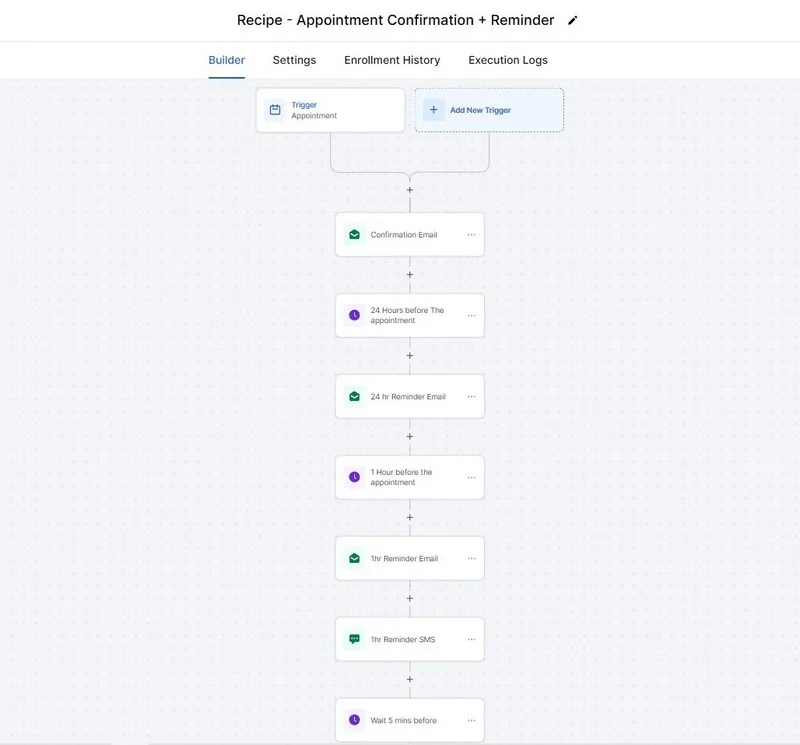
GoHighLevel sends reminders as a workflow that starts when an appointment exists and runs on a schedule you set. HighLevel's dental playbook suggests a 48-hour SMS, a 24-hour email, and a 1-hour text.
The workflow is easy. Keeping it accurate is the hard part. If appointments are created in the PMS, HighLevel only knows about them if something sends them across. If a patient cancels by phone and the front desk updates the PMS but not HighLevel, the patient still receives a reminder for an appointment that no longer exists. Reminders that go out for cancelled visits do more damage to trust than no reminders at all.
A few rules we build into reminder workflows:
- Keep the message body to the minimum: practice name, date, time, and a callback number. Clinical detail such as the procedure does not belong in a text.
- Give each message a clear reply path: "Reply C to confirm, or call us at the number below."
- Add a stop condition tied to appointment status, so cancelled or completed visits leave the sequence.
- Honor opt-outs across every workflow, not only the one that triggered the STOP reply.
We go deeper on schedules, wording, and no-show handling in our guide to GoHighLevel dental appointment reminder software.
How do recall and patient reactivation work in GoHighLevel?
GoHighLevel runs the outreach, meaning the texts, emails, and follow-ups to patients who are overdue for a hygiene visit or who have gone quiet. It does not know who is overdue until your PMS data tells it, so recall is the workflow where the PMS connection matters most.
Recall has two halves. The first half is deciding who is due, which depends on visit history, treatment plans, and the interval each patient is on. That data sits in the PMS. The second half is contacting them and tracking replies, which is what GoHighLevel is good at. If you skip the first half and blast your whole list, you will text people who were seen last week, people who moved away, and people who declined treatment on purpose.
There are three practical ways to feed the outreach, roughly in order of effort:
- Scheduled list import. The front desk runs the PMS report for patients overdue for recall and imports it weekly. It is manual, but it is accurate on the day it runs.
- Bridge or API sync. The recall due date syncs into a HighLevel custom field, and a workflow enrolls anyone whose date has passed.
- Dormant-patient sweep. For patients with no visit in a long window, a separate reactivation campaign runs on a slower cadence with a clearer opt-out.
We cover the message sequence, timing, and what to do with replies in our guide to GoHighLevel dental recall and patient reactivation. One thing worth deciding early: whether recall messages count as treatment communication or as marketing for your practice. That question changes the consent you need, and it is covered in the compliance sections below.
How do you collect dental reviews without breaking Google's rules?
Ask every patient the same way after a completed visit, link straight to your Google Business Profile, offer nothing in return, and never route unhappy patients away from the public page. Google's policy prohibits offering incentives for reviews and discouraging negative ones or selectively soliciting positive ones.
Those are Google's words in its Maps user-generated content policy. Merchants may not "discourage or prohibit negative reviews, or selectively solicit positive reviews." They also may not offer incentives such as payment, discounts, or free goods and services for a review. Many review tools ship with a "how was your visit?" screen that sends 4 and 5 star responses to Google and 1 to 3 star responses to a private form. That pattern is what the policy targets, so we do not build it.
The US Federal Trade Commission's rule on consumer reviews and testimonials, 16 CFR Part 465, took effect on October 21, 2024. Among other things, it prohibits incentivizing reviews on the condition that they express a particular sentiment, and it covers certain review suppression practices. Whether your specific setup complies is a question for your counsel.
What we build instead is plain. A visit-completed trigger sends one text or email with a direct review link. One reminder follows a few days later if there is no click. A separate internal feedback path is open to every patient, in addition to Google and not instead of it. Replying to reviews needs its own care. The HHS Office for Civil Rights settled with a dental practice that answered online reviews with patients' names and treatment details. Staff who reply should never confirm that a reviewer is a patient or mention treatment. Write a short reply policy before anyone answers the first review.
Review requests pair well with local search work. Our GoHighLevel local SEO automation guide covers Google Business Profile in more detail.
Is GoHighLevel HIPAA compliant for a dental practice?
GoHighLevel is not HIPAA compliant by default. HighLevel sells a HIPAA add-on (US$297 a month at the time of writing) that includes a Business Associate Agreement, and HighLevel states that the customer remains responsible for meeting all HIPAA requirements. This is not legal advice.
The details, from HighLevel's own documentation, at the time of writing:
- The HIPAA module costs $297 per month, or $2,970 per year, on top of the plan you already pay for.
- The Business Associate Agreement is signed inside the app, in HighLevel's Documents and Contracts area.
- The agency owner must enable HIPAA on each sub-account manually, in advanced settings.
- HighLevel says the package cannot be canceled, refunded, removed, or downgraded once it is enabled.
- Its support article lists the data covered as contacts, notes, custom fields, SMS and MMS, voice recordings, email bodies and attachments, form and survey submissions, calendars, and invoices.
- HighLevel describes agencies as business associates too, so an agency that can see patient data needs its own arrangement with the practice.
Three practical consequences follow. First, the add-on is a commitment, so decide before you turn it on, and do not enable it on a test account you plan to delete. Second, a Business Associate Agreement covers HighLevel's handling of data. It does not make your workflows compliant. What your staff and automations put into text messages, chatbot answers, and notes is still your decision. Third, every other tool you connect needs its own answer to one question: does it touch patient information, and is there an agreement with that vendor? That includes n8n, Zapier, a bridge app, and any AI voice vendor.
The HIPAA rules for the messages themselves are more forgiving than many practices fear. HHS states that appointment reminders are part of treatment and can be made without an authorization. Its regulation defines marketing as a communication that encourages people to buy or use a product or service, with exceptions including communications made for treatment. Whether a recall or promotion message falls on one side or the other depends on its content and on whether anyone pays you to send it. Get a compliance professional to review your templates. Our team is not a law firm and this page does not replace one.
For a wider view of healthcare builds, including clinics beyond dentistry, see our page on GoHighLevel expert support for US healthcare clinics.
What consent do texts and calls to dental patients need?
Texts and automated calls to patients need consent under the Telephone Consumer Protection Act (TCPA), and marketing messages need stricter written consent than treatment messages. Get consent at intake, record where it came from, and honor every opt-out. This is not legal advice.
The FCC's rule at 47 CFR 64.1200 requires prior express written consent for telemarketing calls that use an autodialer or prerecorded or artificial voice. The same rule treats "health care" messages delivered by or for a HIPAA covered entity or its business associate differently: under paragraph (a)(2) they are exempt from that written-consent requirement. Law-firm summaries of the FCC's orders add conditions, including that messages go only to the number the patient provided, name the provider, and contain no advertising. A reminder for tomorrow's cleaning fits that pattern. A "50 percent off whitening this week" message does not.
What that means in a build:
- Capture consent on the intake form with clear wording, and store the timestamp and form source on the contact.
- Keep treatment messages and promotional messages in separate workflows with separate consent fields, so a reminder consent is never used to justify a promotion.
- Register for A2P 10DLC before sending texts from local numbers. HighLevel's Missed Call Text Back documentation lists that registration, or toll-free verification, as a prerequisite.
- Apply a global stop rule. A patient who texts STOP in one workflow leaves all of them.
The AI calling piece has additional rules. See the compliance section of our AI calling agent service page before you switch on outbound calls.
How much does GoHighLevel cost for a dental practice?
At the time of writing, GoHighLevel's plans run from $97 to $497 a month. A dental practice should also budget for usage charges, the $297 HIPAA add-on if patient information enters the account, and any PMS connection.
| Cost line | Amount at the time of writing | Source |
|---|---|---|
| GoHighLevel plans (Starter, Unlimited, Agency Pro) | $97, $297, $497 a month | gohighlevel.com/pricing, summarized on our pricing page |
| HIPAA add-on | $297 a month or $2,970 a year, not removable once enabled | HighLevel support portal |
| SMS, calls, email, AI usage | Billed by usage; varies with volume | HighLevel usage wallet |
| Bridge app to a PMS (if used) | One listing shows $95 a month per integration plus $115 setup | ghldental.com |
| Autoesta audit | Free | Autoesta |
| Autoesta cleanup or verification | From $200 | Autoesta |
| Autoesta small automation build (2 to 3 automations) | From about $1,000 | Autoesta |
| Autoesta full GoHighLevel setup | About $3,000 to $5,000 | Autoesta |
| Autoesta monthly support | From $200 | Autoesta |
Our build prices are typical ranges, and your scope decides where you land. Builds include six months of maintenance. A group with five or more locations is usually priced as a multi-location project, typically $5,000 to $10,000, and we quote it after a call. The single biggest budget surprise for dental practices is the HIPAA add-on, because it is added at the account level and cannot be reversed. Price it in from the start.
What did Autoesta report for a dental practice?
In our published dental case study, reported by Autoesta, first response to new-patient enquiries fell from 45 to 90 minutes to under 5 minutes, and missed patient enquiries fell by 50 to 60 percent in the first 14 to 21 days. It describes one practice, and results vary.
Smile Bright: reported results
The client was Smile Bright, a general and cosmetic practice in the United States. The build combined a GoHighLevel CRM, automated lead intake from each source, an n8n layer for routing and reliability, an AI calling agent and chatbot, and WhatsApp, SMS, and email automation. The typical timeline for that scope was 20 to 30 days.
Read those figures for what they are. They come from one practice over its first two to three weeks, the practice's baseline was slow, and a practice that already answers in five minutes would see a smaller change. We give every client a baseline before we start so they measure their own change. The full write-up, including the lead-source table and what the practice's team said, is in the dental CRM automation case study, and our other published build is the real estate case study. See the case study index for both.
When is GoHighLevel the wrong choice for a dental practice?
GoHighLevel is the wrong choice when a practice wants a tool that reads and writes its charting system out of the box. It is also wrong when no one will own the automation after launch, or when a PMS-native communication product already covers the reminders and recall you need.
Be honest about these before you buy:
- You want deep PMS integration with no setup. Dental-specific communication products that are built by or partnered with a PMS vendor often connect more directly than a general CRM does. If two-way schedule sync is the whole point, evaluate those first, and check with your PMS vendor which integrations it authorizes.
- You only need reminders. If your PMS already sends confirmations and reminders and your no-show rate is fine, adding GoHighLevel for that alone is more platform than you need.
- Nobody owns it. Automations that message patients need an owner who checks for failed syncs, updates templates, and handles opt-outs. A practice with no such person should budget for ongoing support or pick a simpler tool.
- You cannot commit to the HIPAA add-on. If patient information will pass through the account and you are not ready for a permanent $297 monthly add-on, keep clinical information out of the platform and limit it to lead capture, or choose another tool.
- Your list quality is poor. Recall depends on accurate PMS data. If phone numbers and recall dates are unreliable, fix that first, or the automation will spread the mess faster.
If you already have a GoHighLevel account that has grown untidy, the fix is usually a cleanup and not a restart. Our GoHighLevel expert service starts with an audit.
How do you get started with GoHighLevel for a dental practice?
Start with one workflow that solves a measurable problem, usually new-patient response time or missed calls, and confirm your PMS integration route and compliance choices before you add reminders and recall. A focused first build can be live in weeks, not months.
- Measure your baseline. Count new-patient enquiries, how fast the first reply goes out, and how many calls go unanswered in a typical week.
- Decide the compliance path. Choose whether patient information will be in the account, and whether the HIPAA add-on is needed. Have your own counsel review consent wording.
- Pick the PMS route. Choose from the four routes above, and ask your PMS vendor which integrations it authorizes.
- Build capture and first response first. Add booking and reminders once the front desk trusts the pipeline.
- Add recall and reviews last. They depend on the cleanest data and the most careful consent.
- Test with a real contact end to end. Submit a form, book, cancel, reply STOP, and confirm each step behaves.
Our guide to setting up GoHighLevel properly covers the account structure underneath this, and our GoHighLevel setup service is what we offer if you want us to build it.
Beyond HighLevel, every connecting tool needs its own answer on BAAs. See HIPAA and automation tools, and our guide to reducing no-shows.
More questions about GoHighLevel for dentists
Do you need a GoHighLevel expert for a dental practice?
Not always. A single-location practice with a simple reminder need can use HighLevel's templates. A GoHighLevel expert earns the fee when you need recall tied to your practice-management system, several locations, or HIPAA set up correctly. See our GoHighLevel expert page and the Smile Bright dental case study.
Can GoHighLevel send appointment reminders from Dentrix?
Not natively, as far as HighLevel documents. You need a connection that carries appointment data from Dentrix into HighLevel, such as an approved bridge or an API workflow, or you export and import the schedule. Without one, HighLevel sends reminders only for appointments booked in HighLevel.
Is texting patients allowed under HIPAA?
HHS says appointment reminders are part of treatment and can be made without an authorization, but the content should be minimal and your safeguards still apply. Marketing messages follow different rules. Confirm your approach with a compliance professional. This is not legal advice.
Do I need the HIPAA add-on if I only capture leads?
It depends on whether the account will hold patient information. A form that collects a name and phone number from a stranger is different from a chat where someone describes symptoms. If health details can enter the account, ask your counsel whether you need the add-on and a Business Associate Agreement.
Can GoHighLevel handle multiple dental locations?
Yes. It supports multiple sub-accounts, and the Unlimited and Agency Pro plans have no sub-account cap. Each location still needs its own phone number registration, calendar rules, and PMS connection, so multi-location builds cost more to design and monitor. We also keep tags, pipeline stages, and custom fields identical across locations, so a group can report on all offices in one view and a patient who moves between offices is not treated as a stranger.
Does Autoesta build this for dental practices?
Yes. We have published one dental build, reported by Autoesta. Our healthcare clinics page and our aesthetic clinics guide show the same building blocks in other settings.
What about a chiropractic or wellness practice?
The same recall and reminder logic applies. See our chiropractic and wellness clinic guide.
How do I talk to someone about my practice?
Book a free 30-minute strategy call or use the contact page. Bring your PMS name, your monthly new-patient volume, and your biggest current bottleneck.
Is there a GoHighLevel dental snapshot, and should you use one?
Yes, several vendors sell dental snapshots, and one can save build time. HighLevel's snapshots overview (modified 30 September 2026) says a snapshot copies configuration such as workflows, calendars, pipelines and forms, while contacts, appointments, conversations, third-party integrations and phone numbers do not transfer. So the parts that decide whether a dental build works, the practice-management connection, texting registration, the HIPAA add-on and consent history, still have to be set up in your own account. Our answer on whether snapshots are worth buying covers the trade-off, and our GoHighLevel setup agency page shows what a done-for-you build includes.
How long does a GoHighLevel setup take for a dental practice?
A focused first build, covering new-patient replies, missed-call text-back and reminders, usually takes one to two weeks plus texting registration. A fuller scope like our published dental build, with a PMS connection, AI calling and recall, took 20 to 30 days. Testing the PMS sync on dummy patients is the step not to rush.
What should you ask a GoHighLevel dental consultant before hiring?
Ask four things. In what order will they buy the HIPAA add-on, sign the BAA and connect your PMS? Which connector will they use, and will its vendor sign a BAA? How will they test that a completed visit stops a recall text? Who owns the account if you part ways? A real GoHighLevel expert for dentists answers all four plainly and puts the scope in writing. Our guide to hiring a GoHighLevel expert covers the rest.
How much does texting registration cost for a dental practice?
HighLevel lists a one-time fee of $22.50 for a low-volume or sole-proprietor brand, or $64 for a high-volume brand, each including the first campaign and Fast Track review, then a campaign fee of $1.50 to $10 a month (HighLevel A2P fees, modified 24 September 2026). Each message is billed on top. Our A2P registration guide covers approval and rejections.
Can GoHighLevel take a deposit for a dental consultation?
Yes. HighLevel calendars can collect a payment at booking, either a fixed amount or a percentage, through Stripe or another connected gateway (HighLevel calendar payments). Practices use it for cosmetic, implant or aligner consults rather than routine hygiene visits. Write the refund rule first, so the deposit, the confirmation and the reminder all say the same thing.
Can an AI receptionist answer dental calls in GoHighLevel?
Yes. An AI receptionist can answer when the front desk is busy or closed, take new-patient details, answer approved questions about hours and services, and book or pass the call to staff. Anything that sounds urgent or clinical goes to a person. If call recordings or transcripts hold patient information, the HIPAA add-on question above applies to them too. See our AI receptionist page for scope.
Does GoHighLevel verify dental insurance eligibility?
No. Eligibility checks, claims and the ledger stay in your practice-management system or clearinghouse. GoHighLevel can send a reminder asking the patient to bring or upload current coverage details before a visit, and it can route an insurance question to the right person, but it does not check coverage.
Do you set up GoHighLevel for dental practices outside San Francisco?
Yes. We build remotely for dental practices across the US and in other countries, with the team split between San Francisco, India and Nepal. Calls run on video. Your location mainly changes which state rules your counsel checks and which time zone your reminders run in, not how the build works.
Does GoHighLevel work for orthodontists?
Yes. GoHighLevel for orthodontists follows the same pattern as for general dentists: new patient consults, reminders and recall, with longer treatment follow-up. The dental CRM GoHighLevel setup and a dental snapshot can be adapted to orthodontic stages.
Related: GoHighLevel pricing calculator and CRM automation by industry.
For the full practice system, including AI enquiry handling, recall and reviews, see dental practice automation.
Sources and further reading
- ADA Health Policy Institute
- HighLevel pricing (official)
- HighLevel Help Center
- HighLevel: HIPAA compliance with HighLevel (updated 11 June 2026)
- HighLevel: A2P 10DLC messaging fees (modified 24 September 2026)
- Zapier: Is Zapier HIPAA compliant? (checked 30 September 2026)